.jpg) I. The Holy Community [Hiera Koinotis] of Mount Athos is a permanent governing body consisting of twenty representatives from the holy monasteries, one from each of the leading monastic institutions, who meet in Karyes, the capital of the Athos. (art. 11 of the Charter).
I. The Holy Community [Hiera Koinotis] of Mount Athos is a permanent governing body consisting of twenty representatives from the holy monasteries, one from each of the leading monastic institutions, who meet in Karyes, the capital of the Athos. (art. 11 of the Charter).
Twenty representatives are elected from local monasteries, in accordance with their internal regulations, each year no later than the first fifteen days of January, from among monks who are at least thirty years old and distinguished for their prudent and impeccable life, preferably having theological education and speaking foreign languages (art. 14 of the Charter). The term of service for the representatives of the Holy Community lasts for one year but may continue in subsequent years if the monastery repeatedly elects the same representative (art. 15 of the Charter).
The representatives are equal among each other: their votes carry equal weight and differ only by the hierarchical status of the monasteries they represent (art. 24 of the Charter). They are obliged to inform their monasteries before any administrative or economic matter arrives to the final discussion by the Holy Community. They are also bound by the instructions they receive from their monasteries, except for cases of justice, in which they must make decisions based strictly on their own judgment (art. 16 of the Charter).
II. The Holy Community meets regularly three times a week as well as in urgent cases if necessary (art. 17 of the Charter). The procedure for meetings is controlled by the internal regulations of the Holy Community dated September 23, 1931. Representatives of monasteries residing permanently in Karyes are required to attend the meetings regularly and without fail, except for confirmed cases of illness. If a representative is absent from two consecutive meetings without a valid reason, they must provide a written explanation to the Holy Community, which may impose a reprimand. Ιn case of repetition, the monastery may be requested to appoint a different representative. If it refuses to make any replacement, the Holy Community has the right to deprive the monastery of its representative for a period of three to six months (art. 19 of the Charter).
The list of issues that have to be discussed each day is prepared by the Holy Superintendence and is distributed to the representatives the day before each meeting. It also indicates the order of discussion. In the case of an urgent matter, it may be considered out of order by decision of the Holy Community. (art. 18 of the Charter).
Protepistatis holds the chair of each meeting. He presents issues for discussion, attributes speaking time to representatives in the specific hierarchical order of the monasteries they represent, and may withdraw the speaking rights if a speaker exceeds the bounds of propriety. If any representative is removed from the room twice, the Holy Community shall request the monastery to urgently replace them with another. (art. 23 of the Charter).
A quorum is deemed valid when two-thirds of the members are present at a meeting, that is, fourteen representatives. If any members leave during the meeting for any reason, the meeting continues, and the decisions made remain valid as long as at least eleven representatives are still present (art. 21 of the Charter). The governor may also attend the meetings by invitation, holding only an advisory vote. His invitation becomes mandatory if requested by eight or more participants (art. 4 of the Legislative Decree dated September 10, 1926).
Decisions of the Holy Community are made by majority vote and recorded in a special book (art. 21 of the Charter).
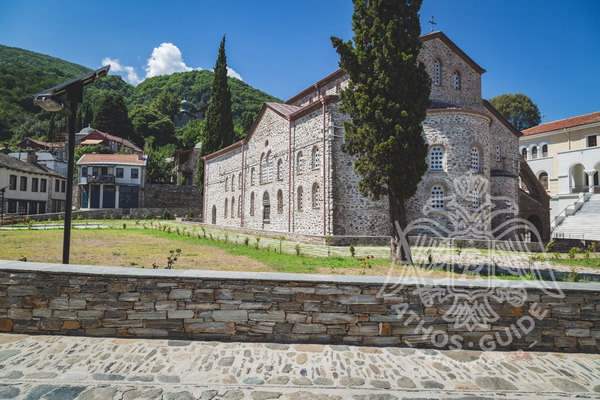 Representatives have the right to record their opinion in the meeting minutes. However, they cannot refuse to sign these documents under any circumstances. Those who refuse are subject to punishment for intentional obstruction (art. 22 of the Charter). Decisions are considered final only after being signed, and only then are the corresponding documents "issued." In these documents instead of signatures of the representatives it is contained the notation: "all representatives at the Holy Community and heads of the twenty holy monasteries of Mount Athos," along with the seal of the Holy Superintendence (art. 25 of the Charter). Such documents are always drafted in Greek (art. 26 of the Charter).
The Holy Community is supported in administrative matters by the chief secretary, who is a monk from one of the Athonite monasteries. He must be over 25 years old and hold a university degree or have completed a school of theology. In exceptional cases, and if deemed appropriate, a high school diploma may be sufficient. He has at least one assistant. The chief secretary attends meetings without voting rights, presents issues for discussion, keeps the Community's books and archives, prepares minutes, and generally ensures the proper functioning of the Holy Community's office (art. 38-39 of the Charter).
III. The Holy Community has administrative and judicial powers, which will be discussed in a dedicated section. The administrative powers of the Holy Community, which is formally elevated to the rank of "supreme supervisor on the faithful observance" of the Charter (art. 121 of the Charter), include the approval of the internal regulations of the monasteries of Mount Athos, checking their compliance with the provisions of the Charter, and overseeing implementation of these regulations in the life of all monasteries (art. 9 of the Charter).
A special duty is imposed on the Holy Community by the Constitutional Charter in cases where the financial condition of a monastery deteriorates to the point of raising concerns for its future. In such cases, the Holy Community requests individuals from that monastery to provide an accurate report on the monastery's income and expenses, debts and loans. If the examination of this data leads to the conclusion that the monastery is indeed in a state of economic crisis, the Holy Community takes all necessary measures to improve the situation on its own initiative (art. 27 of the Charter).