I. The Holy Superintendence [Hiera Epistasia] is a four-member body. For its formation, the twenty monasteries of Mount Athos (Art. 1 of the Charter) are divided into five groups of four, according to their hierarchical order, so that the head of each group is one of the five sovereign monasteries. These groups are formed as follows (Art. 28 of the Charter):
- Great Lavra, Dochiariou, Xenophontos, Esphigmenou;
- Vatopedi, Koutloumousiou, Karakallou, Stavronikita;
- Iviron, Pantokrator, Philotheou, Simonopetra;
- Hilandar, Xiropotamou, St. Paul, Grigoriou;
- Dionysiou, Zografou, Russian, Koutloumousiou.
Each group of monasteries constitutes annually the Holy Suprintendence, from June 1st to May 31st of the following year. Thus, within a five-year period, all monasteries have equally participated in the body. To this end, each monastery involved in the rotation appoints an Epistatis, who has comparable duties to the monastery's representative to the Holy Community.
All members are equal, with the Protepistatis being the first among equals. Decisions are reached by majority. Decisions are made by majority vote, and in the case of a tie, the matter is referred to the Holy Community, which makes the final decision. (Art. 29 of the Charter).
Any decision of the Holy Superintendence made in the absence of one of its members is invalid. Any unilateral and arbitrary action by one epistatis is also invalid, while the refusal to perform their duties may lead to consequences, including the demand of the Holy Community to appoint a replacement (in cases of repeated negligence) (Art. 29 and 32 of the Charter).
Each monastery may nominate the same person who represents it in the Holy Community to also serve as epistatis, except for the monastery to which the Protepistatis belongs. In this second case, the Holy Community does not recognize him, and the office continues to be held by the previous one, until the monastery elects a new candidate. (Art. 34 of the Charter).
The seal of the Holy Community depicting Theotokos "Our Lady of the Sign" (Platytera), with the inscription "Seal of the Hiera Koinotis of Mount Athos" all around its perimeter, consists of four parts. According to established order, it is handed over annually to the new epistates, each of whom holds one of its parts. (Art. 31 of the Charter). In the absence of any of the members, their part of the seal is transferred to their trusted representative. It cannot be given to another epistatis, while in the absence of all representatives it is given to the chief secretary (Art. 30 of the Charter).
The epistates reside permanently in Karyes. However, they may be absent in turn, following the hierarchical order of their monasteries, in order to attend to matters related to their office. This does not apply to the Protepistatis, who is not permitted to leave his position under any circumstances (Art. 33 of the Charter).
Finally, the chief secretary of the Holy Community also provides support to the Holy Superintendence as described above (see § 8 II).
II. The primary duty of the Holy Superintendence is to execute the decisions of the Holy Community. Therefore, it represents the executive authority of Mount Athos, while, in addition, it has responsibilities of the Municipality and the Magistrate's Court (Art. 40 of the Charter).
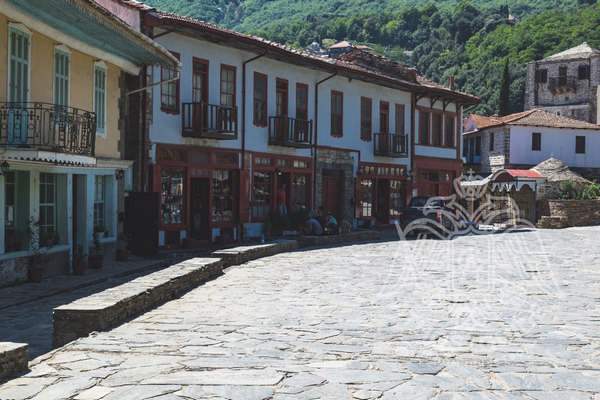
The Holy Superintendence is responsible, among other things, for the transmission and sealing of the correspondence of the Holy Community. Furthermore, it oversees the maintenance of cleanliness, cares for road repairs and lighting in the capital of Mount Athos, conducts sanitary inspections, sets prices for food, monitors store hours, and supervises visitors behavior. It has the authority to expel from Mount Athos those who violate the rules of decency, with the assistance of law enforcement and the police of the Athonite State (Art. 37 of the Charter).
 It also manages the common treasury of the Holy Community. Responsibility for this is assumed by the monasteries to which the members of the body belong. (Art. 35 and 36 of the Charter). The treasury is managed based on a budget determined by the Holy Community. Any expenditure not provided for therein must first be approved by it. If not, the expense shall be borne by the epistates responsible.
All expenses must be certified with receipts, which are attached to a report submitted every six months to an audit committee elected by the Holy Community.
Regarding the common treasury, it is funded, according to the traditional regulation, by all monasteries, hermitages, and cells, which are required to contribute according to the percentage determined for each by the extraordinary assembly of the twenty monasteries. The funds collected are used to cover the needs of the vestry, the school of the Protaton, the commissioner operating outside Mount Athos, the salaries of the law enforcement officers, as well as other regular and extraordinary expenses.