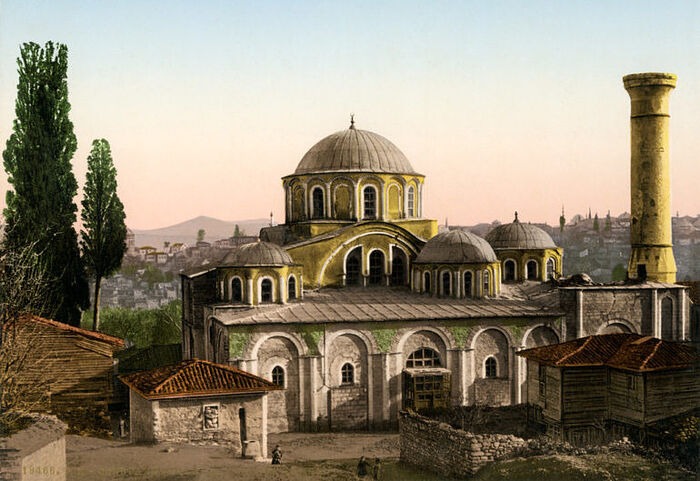
As both historical and aesthetical object, the Chora (or Kariye) church has always been subject to much research by scholars and archaeologists. At the same time, it attracts a large number of believers who wish to feel the holiness and admire its incomparable beauty of this place.
On the 6th of May 2024, following a decision by the Turkish government, the monastery reopened as a Muslim mosque, which caused a strong reaction in the religious and scientific world.
A little bit of history
According to tradition, the Chora church was founded in the 6th century by Saint Theodore. Other narratives link its foundation to Crispo, the son-in-law of Emperor Phokas. Today we know that the catholicon of the monastery was built in 1077-1081 by Maria Doukaina, who was the mother-in-law of the Emperor Alexios I Komnenos. The foundations of the church were laid on the ruins of pre-existing older buildings.
In 1120, the church was restored by Isaac Komnenos, while in 1316-1321 Theodore Metochitis continued its maintenance and expansion. During the Palaiologan era, the decoration of the monastery was enriched with frescoes and mosaics of distinctive beauty.
Why is it called “Chora” church?
During its reconstruction, the monastery was dedicated to Christ the Savior and named "Monastery of St. Savior in Chora". The word “Chora” (χώρα), which means “country” in Greek, was related to the location of the church and its history. Byzantines used this word to refer to the land that extended beyond the walls as formed by Constantine I. When Theodosius II built the new walls, the church retained the nickname despite the fact that it was now located inside the city. According to other sources, the name comes from the depiction of "Χώρα των Ζώντων" (Land of the Living), with Jesus Christ blessing believers as they enter the temple, as well as from the depiction of the Mother of God as "Η χώρα του αχωρήτου" (A Container of the Uncontainable). Greek Orthodox Church epithet of the Mother of God as the vessel that contained the infinite deity. The word "chora" here translates as "container".
The monastery after the Fall of Constantinople
After the Fall of Constantinople in 1453, the Monastery of Chora, like all the monasteries and churches in the city, passed into the Ottoman occupation. In particular, during the period of 1481-1512 it functioned as a mosque, following the decision of the Grand Vizier of Sultan Bayazid II. 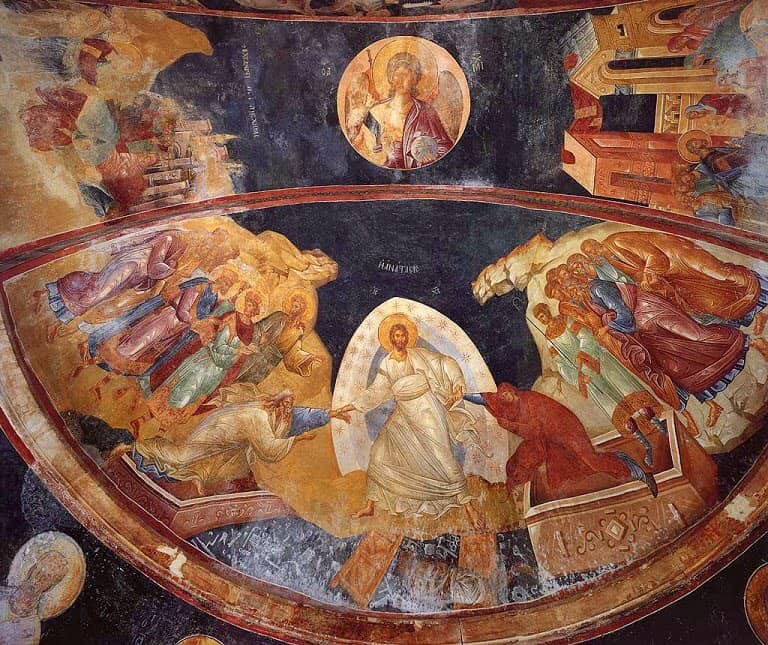 During this period, it was given the name of the Kariye Mosque, which is still used today. A significant part of the frescoes was covered with lime, which, over the years and due to poor maintenance, caused serious damage to the interior decoration and the general appearance of the building. In 1948 it was decided that the monastery would be used as a museum. Thus, restoration works began, and eventually the monastery welcomed its first visitors.
The interior decoration
The monastery of Chora has often been characterized as a masterpiece of Palaeologan art. The mosaics, the frescoes and the general iconographic program have made the church an emblem of Byzantine art and history. The bright colours and the structure of the compositions that surround them, contribute to the sense of wonder that each visitor experiences when entering the temple.
The mosaic of the Dormition of Our Lady, where Jesus Christ is depicted holding the soul of His Holy Mother in His hands, is particularly impressive. The chapel is dominated by the fresco of the "Descent into Hades" and the depiction of the Mother of God who expressively embraces her Son.
World Heritage Site
Following the Turkish government's recognition of the monument as a museum in 1948, the Byzantine Institute of America undertook the restoration and conservation of the monastery. As a result, the monument was preserved in excellent condition, while its mosaics and frescoes were restored. It was recognized by UNESCO and registered as a protected site of symbolic and cultural heritage.
Reopening as a mosque
In 2019, the Turkish authorities decided to reopen the Chora Monastery as a Muslim mosque. On the 6th of May 2024, the first religious rituals took place and the site opened as a mosque. The mosaics and frescoes that depict Jesus Christ, the Mother of God and the Saints were partially covered with curtains in order to make the space consistent with the principles of the Muslim religion.
The reopening of the monastery under the new regime has provoked strong oppositions both from believers, who wish to maintain a neutral and protected use of this sacred space, and from the scientific community, concerned about the interventions and the damage that could be caused.