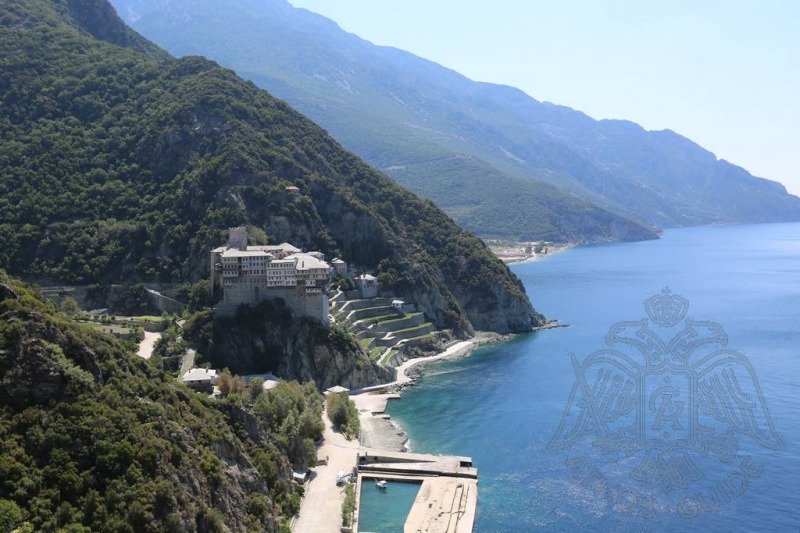
«When we traveled to Mount Athos, we were a group of four pilgrims. On the day of the Feast of the Exaltation of the Holy Cross, at 6:30 in the morning, we departed from Ouranoupoli aboard the boat Saint Anna. Our first destination was the Holy Monastery of Dionysiou. Already on the boat, we began discussing and organizing the schedule we would follow during our stay. At the same time, we were deeply moved by the piety of our fellow travelers, who, before taking their seats, prayed and reverently venerated the large icon of Saint Anna. From the very first moment of the journey, even before setting foot on the sacred land of Athos, we felt the peace and loving care of Theotokos. Our thoughts and emotions softened.
We sailed along the Athonite coastline, passing the monasteries of Dochiariou, Xenophontos, Saint Panteleimon, Xiropotamou, Simonopetra, and Grigoriou. We felt an inner urge to pray and repent.

When we finally arrived at the Monastery of Dionysiou, we found no one outside. It was exactly nine o’clock in the morning, and everyone had gathered in the church, where the vigil for the feast was still in progress. We did not want to lose a single moment. We left our belongings and followed the monks. The Divine Liturgy was celebrated by the abbot of the monastery, Father Peter.
The very low tone of his voice underscored the deeply contemplative character of the Athonite rituals. The monks glorified the Lord in silence. When the Divine Liturgy ended, we went up to the archontariki. After being welcomed by the monks, who offered us loukoumi and raki, we were led to a room next to a small balcony with a magnificent view. To the directly opposite side there was a reception area and a library for visitors.
“Do you know about the miracle that took place here many years ago, on this very small balcony?” asked one of the pilgrims who had stopped to admire the view. He then told us the following story:
“One winter evening, several years ago, a young novice monk was in the library, cleaning and arranging the books. Looking out the window, he saw the figure of a monk heading toward the spot where we are now standing. Thinking it was one of the brothers from his community, he went outside to speak to him. However, the moment he stepped through the door, he saw the image of the monk dissolve before his eyes.
Trembling and filled with fear of the devil’s evil acts, he immediately informed the first brother he encountered. The latter, who was much older and had lived in the monastery for many years, reassured him, saying: ‘Do not be afraid. The Forerunner often visits our monastery. He loves it greatly and is its protector.’”
This story deeply impressed us. It was not only the greatness of faith, the presence of Saint John the Forerunner, and the sanctity of the place that moved us. More than that, it was the naturalness and certainty with which the elder monk had responded. The saint himself had visited the monastery!
After this brief tour, we were given time to rest. Later, we prepared ourselves and went to the monastery cemetery. The silence there was unparalleled. We wondered how much beauty could exist in a place that many would consider dark and avoid visiting. At the entrance, there stood the grave of Saint Niphon, Patriarch of Constantinople, who had lived in the monastery centuries earlier as a simple monk. He dwelt there humbly, practicing obedience and caring for the monastery’s mules.
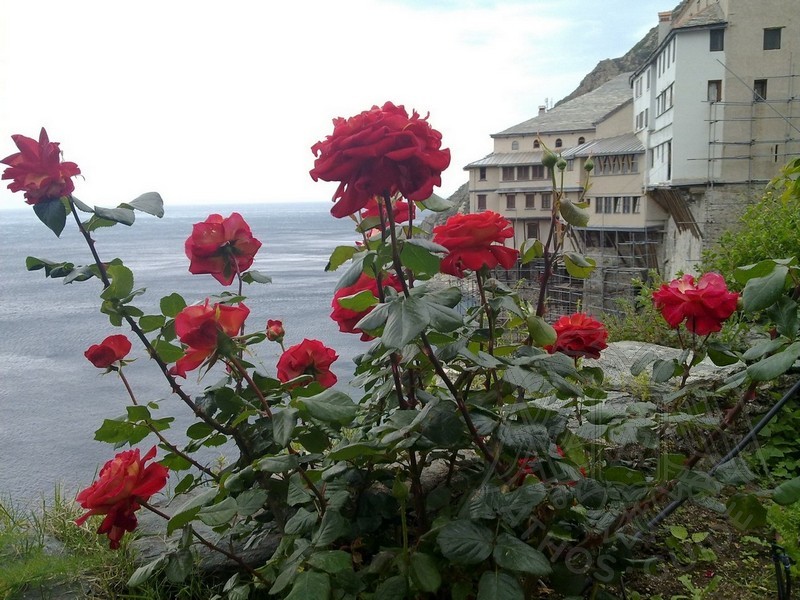
At the Holy Monastery of Dionysiou, there was a custom according to which anyone wishing to join the brotherhood had first to undertake obedience by personally caring for the mules, for as long as the abbot deemed necessary. The novice was also required to chop wood and carry out every kind of humbling task. If he proved worthy and obedient, he would then become a monk and be formally received into the brotherhood. As a novice, the saint fulfilled these duties with diligence and humility, praying constantly and filled with faith in God.
At one point, envoys from Constantinople arrived, sent by the emperor to ask him to assume once again the patriarchal throne. However, he had introduced himself to the community under the name Nikolaos. He even hid himself, and thus they were unable to find him.
During that same period, many pirates were attacking the monasteries, stealing their treasures and killing monks. The fathers had therefore established guard shifts in order to watch over the monastery day and night.
At one point, the saint himself was assigned to guard a section of the monastery. There, in the silence of the night, he surrendered himself entirely to prayer. Suddenly, several virtuous monks, who were at the vigil, saw at the place where the saint was standing, on the far horizon, a pillar of light rising toward heaven. Moreover, the monk who was with him saw him wrapped in tongues of fire.
Terrified, he ran to the monastery and recounted to everyone what he had seen. His words were confirmed by the monks who were keeping vigil. The incident was reported to the abbot. The brotherhood gathered and prayed to the Lord, asking Him to reveal who this man could be to possess such characteristics of holiness. God heard their prayer and did not delay in revealing the truth.
The abbot of the monastery saw John the Baptist appear before him and say: “How long will the Patriarch serve as a guide for your mules? Gather the entire brotherhood and go to receive Patriarch Niphon. Offer him the honors he deserves. He has shown such humility that would astonish even the angels!”.jpg)
After this vision, the abbot awoke in a state of ecstasy. He quickly assembled the entire brotherhood and, deeply shaken, recounted to them all that he had seen and heard. When the brothers learned the truth, they marveled at the spiritual strength with which the saint had carried out his humble duties for so long.
Without delay, they went out with lit candles and incense, waiting to receive Saint Niphon, who was returning from the pasture with the mules. When he saw the monks waiting for him, he bowed his head and approached them in tears.
The abbot asked his forgiveness, venerated him, kissed his holy hands, and said: “You have tested your patience enough, Patriarch of all Christians and light of our souls. Enough of the humiliations that we, wretched as we are, unknowingly imposed upon you. Forgive us!”
The entire brotherhood fell repentantly at his feet. Thus, they rendered honor to a man who had been a model of humility and the glory of Jesus Christ. At the place where this meeting occurred, a sacred monument was later placed in honor of the great saint.
Right beside his tomb there stood an ossuary containing hundreds of skulls of monks who had lived and completed their earthly lives in the monastery. Beneath the tall trees of the cemetery rested, among others, the abbots of the recent history of Mount Athos.
Among them, there was the great teacher of spiritual prayer, Elder Joseph the Hesychast. We venerated all the graves and began recounting the stories we knew of the holy figures of Athos. The next three hours passed quickly. Even today, the moments we experienced there remain among the most significant and revelatory of our lives.
After Vespers and supper, we went to venerate the holy relics of the saints. Among them, there was the hand of Saint John the Baptist, before which we bowed in awe and reverence. His grace was indescribable.
.jpg)
As we were still trying to absorb the wondrous images and impressions of our first day on Mount Athos, sitting at the entrance of the monastery and gazing at the blessed blue of the sky, we were asked to return inside. A monk was preparing to guide a group of Russian pilgrims to the monastery’s sacred treasures. Thus, we followed him.
Priceless treasures were revealed before us. Everything seemed to breathe within the ancient history of the place. Sacred objects, chalices, and vestments of saints (such as those of Saint Niphon) carried our consciousness back to eras of religious grandeur and spiritual beauty.
Before going to sleep, we sat in the library and spoke about everything we had experienced during that first day. We felt our faith growing stronger. Suddenly, we fell silent when a pilgrim slowly entered the room together with his son. The boy was about ten years old, and it was obvious that he was suffering from cancer. We continued our conversation, trying to conceal our discomfort and anxiety for the child’s health. All of us had children, and we deeply empathized with the hardships this family was facing.
One of us approached and asked the boy, “What is your name? Do you play football, Apostolis?” “Of course,” he replied. “He’s a midfielder,” his father added.
We talked for quite some time, until our friend gave the little boy an icon of Saint Jude the Apostle. “You know, my little one,” he said, “this saint speaks with Christ every day. Ask him for whatever you wish, and he will help you.”
The child took the icon of the saint and held it with both hands. His quiet murmuring made it clear how deeply we needed one another and, together, how much we all needed our Lord.»
