According to the Gospel, Palm Sunday is the day on which Jesus came from the city of Bethany to Jerusalem. It was preceded by the resurrection of Lazarus on the Mount of Olives and followed by a dinner at the house of the resurrected Lazarus. His sisters, Martha and Mary, were the ones attending to Jesus. Among other things, Mary opened a bottle of the most expensive and precious myrrh and anointed his feet. According to the Gospel, Judas complained, thinking that the monetary value of this myrrh should be given to the poor rather than being wasted thus. However, Jesus told him:
"Leave her, for she offers that myrrh for the day of my burial. You will always have the poor with you, but you will not always have me.”
He thus stresses the value of devotion to himself, and emphasizes on love and sacrifice as conditions that are realized not only through the acts of solidarity, but above all, through the transcendent sacrifice to God, who himself is love and sacrifice.
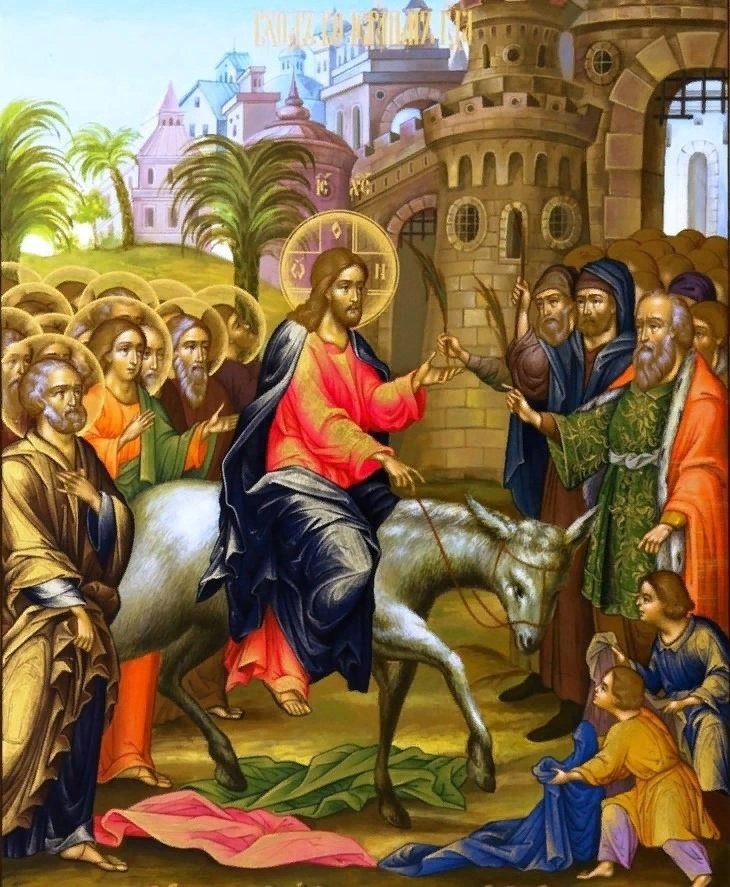
After this episode that took place in Bethany, the Gospel passage describes the crowds of Jews gathered in Jerusalem for the celebration of Easter. Hearing that Jesus was coming to the city of Jerusalem, people took palm branches, a symbol of triumph in ancient times, and gathered in the streets to welcome him. He was seated on a donkey. As he was entering the city, the crowds cheered him shouting:
"Hosanna, blessed is He who comes in the name of the Lord, the King of Israel."
In Jesus they saw the king foretold in the Old Testament, the one who would set them free and rescue them from the yoke of the Romans.
Theological significance of the feast
The significance of Palm Sunday lies precisely in the emergence of Jesus as the king who comes to save his people. He enters Jerusalem as victorious, surrounded by the crowd that greets him lavishly and enthusiastically. Nonetheless, he has no guards or wealth; he is seated on a donkey, accompanied only by his disciples, and in general, doesn’t appear to be a powerful king. Thus, focusing on a spiritual approach of the event, one can easily notice the contradiction between the superficial enthusiasm of the crowd and the essential significance of the grace that Jesus brings as he enters Jerusalem. The crowd cheers him, considering him a secular king who has come to free them from their political enemies, the Romans. He, however, enters the city humbled. He promises not political change, but spiritual salvation and victory over death. Indeed, as it is revealed through his reply to Judas, he is already prepared for the Passion that will follow. In this light, the event of his entry into the city of Jerusalem takes on a bittersweet connotation. The behavior of the crowd, though showing admiration, is no more than an expression of immature and superficial emotions. It will quickly turn into hatred, and a short time later the same crowd decides on his crucifixion.
Tradition
 In the early Christian years, Palm Sunday was celebrated by re-enacting the event. Specifically, in the 4th century the bishop would start from the Mount of Olives in the Holy Land and walk down to Jerusalem, surrounded by the priests and people carrying palm branches.
In Byzantine times, the same re-enactment was performed with the participation of the emperor, hence the name "The Emperor's Walk". The latter would walk through the city of Constantinople holding the image of Christ, accompanied by the priesthood. The procession would end at Hagia Sophia church. According to testimonies, the emperor was then distributing palm branches to the crowd, while the Patriarch was offering candles for the Holy Week.
The same custom took place in Russia, where the same procession was taking place in the presence of the Tsar. The procession would start from the Kremlin and end at the cathedral.
Today, we celebrate Palm Sunday with the Palm Sunday service. Priests distribute laurel branches that resemble the branches of the palm tree.
Fasting
On Palm Sunday, it is customary to eat fish. Although there have been different views on the subject, Palm Sunday is considered a feast and is therefore honored as such. Specifically, it is considered that the fast of Lent ends on the Sabbath of Lazarus, while the fast of Holy Week begins on Holy Monday. Sunday is the end and the beginning of the two fasts and, given its festive and triumphant character, it is allowed to celebrate by eating fish.
Apolytikion
“Oh Christ our God, before Your Passion, You raised Lazarus from the dead to confirm the common Resurrection for all. Therefore, we carry the symbols of victory as did the youths, and we cry out to You, the victor over death, “Hosanna in the highest. Blessed is He who comes in the name of the Lord.”
Kontakion
“In Heaven, He is seated upon a Throne and on earth He rides upon a foal. O Christ our God, Accept the praise of the Angels and the hymn of the Children who cry out to You, “Blessed are You who comes to recall Adam.”