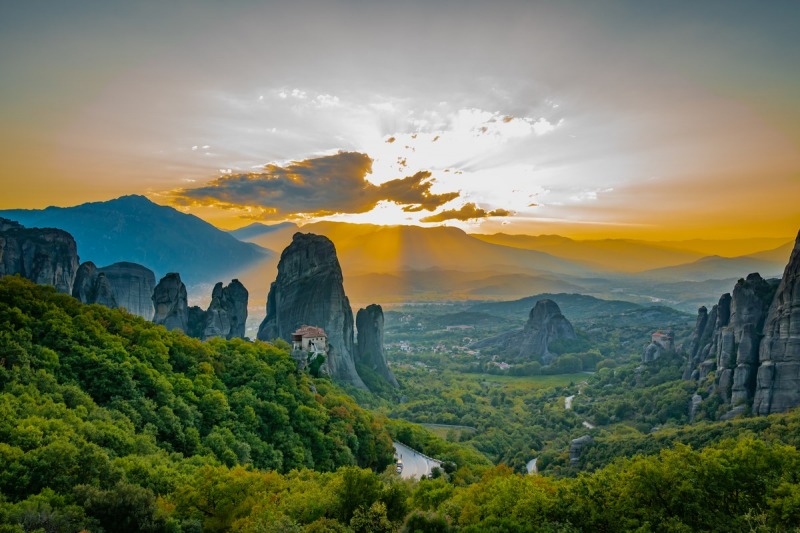
The Mountains of Meteora, with their steep cliffs and stone-built monasteries, could be recognized as the eighth wonder of the world. These ancient monasteries, perched high upon towering rock pillars, rank among the oldest monastic foundations in Greece. After Mount Athos, Meteora constitutes the second most important center of Orthodox monasticism. It is a sacred destination that every Christian should visit and venerate.
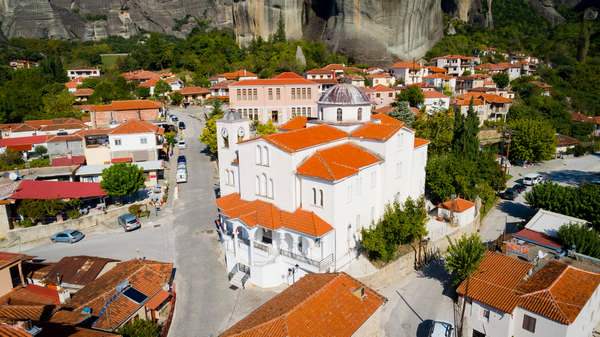
Located in the region of Thessaly, near the town of Kalambaka, Meteora is recognized as a UNESCO World Heritage Site. The monasteries are closely connected with Athos, as they were founded by the same person. Saint Athanasios the Athonite, fleeing the pirate raids that threatened Mount Athos during the 14th century, settled in the isolated and inaccessible rock formations of Meteora. There he established the first monastery, the Great Meteoron. Much later, monks from the region, seeking greater silence and spiritual stillness, travelled to Athos and founded the Monastery of Simonopetra.
Unlike the monastic state of Mount Athos, women are permitted to visit and venerate the monasteries of Meteora, making the area a particularly popular destination for families.
The History of Meteora
The impressive rock formations of Meteora rise majestically above the plains of Thessaly, between Mount Koziakas and the Antichasia mountains, just northwest of the small town of Kalambaka. This rocky sacred complex is home to the second most important monastic community in Greece and one of the country’s most renowned tourist destinations.
The monastery buildings appear as a natural extension of the rocks themselves. From a distance, visitors often feel as though they could touch the sky from the mountaintops.
Centuries ago, the monastic complex of Meteora developed at the top of these gigantic rock pillars, many of which exceed 200 meters in height. The harmonious coexistence of Byzantine architecture and the natural beauty of the landscape is truly remarkable.
The dramatic scenery, shaped by a unique geological formation, inspires awe, while the Byzantine monasteries standing atop the cliffs continue to survive to this day, defying the limits of human imagination.
Six of the original twenty-four monasteries remain still active today. Founded centuries ago, they continue the tradition of Orthodox monasticism for more than 600 years, preserving priceless relics, ecclesiastical treasures, ancient frescoes, and outstanding examples of Byzantine art.
In 1988, the monasteries of Meteora were included in the UNESCO World Heritage List, while the surrounding region became part of the Natura 2000 network due to its rare species of flora and fauna.
The Formation of the Monastic Community
The exact date of the first settlements in Meteora remains unknown. However, according to Byzantine scholars, the earliest monastic communities were formed before the 11th century. Other historical sources identify the monk Barnabas as the first hermit of the area, having founded the Skete of the Holy Spirit between 950 and 970 AD. This was followed by the foundation of the Skete of the Transfiguration by the Cretan monk Andronikos in the early 11th century, as well as the Skete of Doupiani, also known as the Skete of Stagoi, founded between 1150 and 1160 AD.
The name “Meteora,” derived from the Greek adjective meteōros, means “suspended in the air”. Saint Athanasios gave this name to the broad rock upon which he first settled in 1344. Over the following two centuries, twenty-four sacred monasteries were established throughout the region.
The Rise and Decline of Monasticism in Meteora
Within this wild and inaccessible landscape, marked by dark sandstone cliffs reaching heights of 200 meters and widths of 300 meters, ascetics discovered an ideal environment for monastic life. Initially, they prayed in small and isolated chapels.
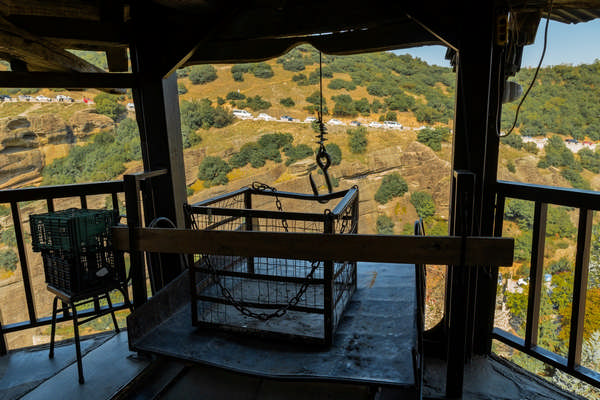
Some monks eventually climbed the immense rock pillars using wooden scaffolding supported by beams fixed into the stone. For many years, access depended on rope nets and baskets, while the first carved stone steps appeared only in the early 20th century.
The monastic state of Meteora experienced its most significant decline after the Fall of Constantinople and the collapse of the Byzantine Empire during the 15th century. Yet from the late 15th century onward, and especially during the 16th century, a new flourishing period began. New monasteries and monastic buildings emerged across the rocky landscape, while remarkable frescoes of exceptional artistic value were created during the same era.
The monastic community of Meteora reached the height of its prosperity during the 17th century. This golden period was eventually followed by another decline, as invasions, looting, harsh living conditions, and shortages of essential goods forced many monks to abandon their monasteries, sometimes after destroying them before departing.
Today, six monasteries remain active, continuing their spiritual mission uninterruptedly. These are the Monastery of the Transfiguration of the Savior (Great Meteoron), the Monastery of Varlaam, the Monastery of Saint Nicholas Anapausas, the Monastery of the Holy Trinity, the Monastery of Rousanou, and the Monastery of Saint Stephen.
Visiting the Monasteries of Meteora
As previously mentioned, six of the original twenty-four monasteries built atop the giant stone pillars remain active today, having been restored and regained their former splendor. Remarkably, most of their frescoes have survived in excellent condition, highlighting the significance of the iconographic tradition of Orthodox Christian civilization.
Monastery of the Transfiguration of the Savior (Great Meteoron)
The Monastery of the Transfiguration of the Savior is the oldest and largest monastery in Meteora. Situated on the highest rock formation, it dominates the entire monastic complex. Part of the monastery now serves as the main museum space of Meteora, displaying important relics and treasures to visitors.
The Holy Altar of the central church is adorned with frescoes of exceptional beauty, created according to the iconographic style of the Macedonian School. The sacristy is also one of the monastery’s most significant areas, as it preserves the skulls of monks from throughout the monastery’s long history.
Monastery of Varlaam
The Monastery of Varlaam was established during the 16th century. Its name derives from the hermit Varlaam, who first settled there in the 14th century. The founders of the monastery are considered to be the brothers Nektarios and Theophanes, who originated from Epirus.
The monastery is renowned for its rich and extensive archive, housed within its museum, which contains valuable manuscripts, rare ecclesiastical relics, post-Byzantine portable icons, and other important treasures.
Monastery of Saint Nicholas Anapausas
This is the first monastery encountered by pilgrims ascending from Kastraki on the left-hand side. It dates back to the 14th century and was restored during the first decade of the 16th century.
The frescoes of the main church, painted in 1527 by the Cretan artist Theophanes Strelitzas, are considered among the finest examples of post-Byzantine painting. They also constitute the earliest signed work of the artist. The monastery was abandoned from the early 20th century until the 1960s, when it was renovated and restored by the Archaeological Service.
Monastery of the Holy Trinity
The Monastery of the Holy Trinity is the highest and most inaccessible monastery in Meteora. Visitors must climb 140 steps carved directly into the rock in order to reach it. However, the demanding ascent is rewarded with breathtaking views over the valley of Kalambaka and the Pineios River.
It is the third oldest monastery. According to tradition, the first hermits built their sketes here during the early 14th century. The construction of the monastery, along with the transportation of materials to such an altitude, lasted approximately seventy years.
From 1942 to 1961 the monastery was abandoned, while restoration works were completed in 1972. In 1909, rare manuscripts were discovered in its crypt. These are now preserved, together with those from the monasteries of Rousanou and Saint Nicholas, in the sacristy of the Monastery of Saint Stephen.
Monastery of Saint Stephen
Directly above Kalambaka, on the southern side of the complex, there stands the Monastery of Saint Stephen. It is the easiest monastery to access, connected to the main road by a small bridge.
The monastery holds a distinguished place within Orthodox Christianity, particularly due to its contribution to the Greek national liberation struggles. During the Macedonian Struggle, it served as a headquarters and refuge for fighters.
Today, the old refectory houses the monastery museum, where important relics are preserved, including textiles, manuscripts, post-Byzantine icons, wood carvings, and other ecclesiastical treasures.
Monasticism in Meteora
The driving force behind the creation of these extraordinary structures upon the rugged rocks of the Thessalian plain was love for God, the monastic life, and asceticism. Monasticism is regarded as the highest and most virtuous form of life, the complete dedication of the human person to Christ. It is considered an earthly imitation of the state of the angels and an expression of divine love within the material world.
 The life of the monks represents a total opening of the soul to God, a continuous struggle of prayer and holiness.
Throughout their long history, the monasteries of Meteora served as true guardians of the traditions of the Greek nation and Orthodox civilization. During the Ottoman occupation, they sheltered schools for impoverished Greek children, provided refuge for the persecuted, and organized food centers for resistance fighters.
For many centuries, the monasteries hosted countless monks, forming a crossroads of faith and culture, a treasury of values and virtues of the Greek Orthodox spirit. Today, they uniquely combine incomparable natural beauty with subtle human intervention, spiritual devotion with hospitality, dedication to God with culture, and the strictness of ascetic life with the refinement and sensitivity of art.
During the past fifty years, thanks to the philanthropy and tireless efforts of the abbots and monks of the region, in cooperation with the Archaeological Service, an immense restoration project has been carried out across the monastic complex.
The Life of the Monks
The life of the monastic communities of Meteora is centered entirely around the worship of Christ. The monks serve the many visitors with love and sensitivity, while preserving and protecting the unique character of the sacred site.
They engage in icon painting, manuscript illumination, the production of candles, incense, and icons, as well as beekeeping. In addition, they write historical, theological, and hymnological studies.
However, above all they strive to offer a living testimony to the love of God in an age marked by spiritual dryness. Their constant struggle is to preserve the precious heritage of the Orthodox faith and the richness of its traditions.