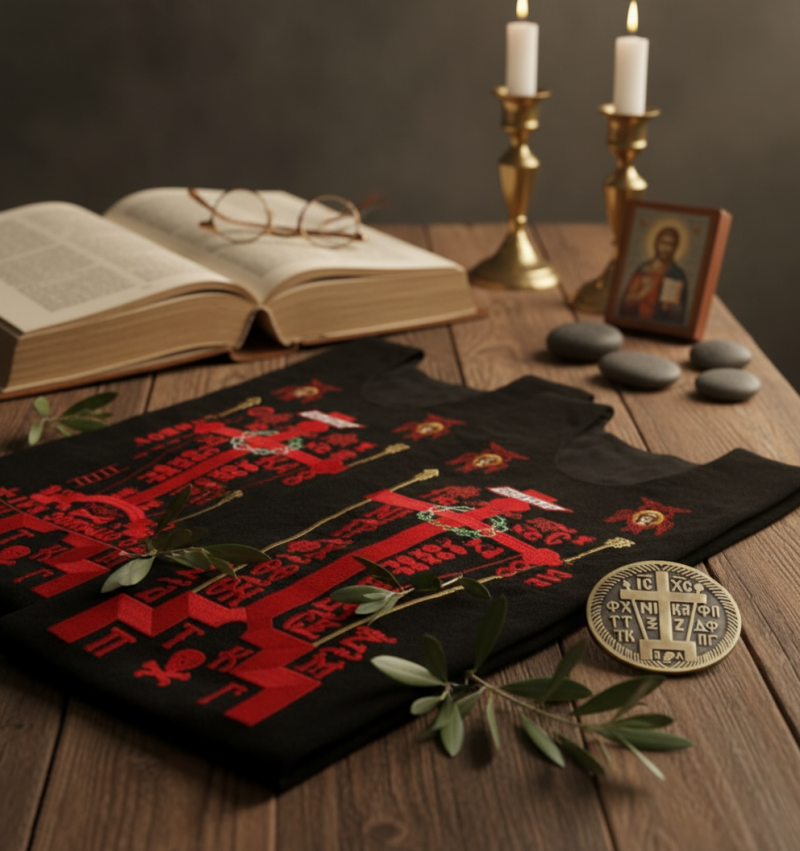
The great and angelic schema is the highest stage of monastic life. It is attributed to monks who have been distinguished for their ascetic struggles and have managed to overcome the trials of their spiritual life. It is a second baptism, corresponding to the ceremony of monastic tonsure. It is the highest honor for ascetics who have come to this stage.
The title of the great schema is accompanied by the corresponding vestment, which the monk adopts, symbolizing his renunciation of all worldly things and his complete devotion to God.
Specifically, the great-schema monk wears a hood with a pointed triangular top, the analavos (or polystavri) and the great schema. His body is wrapped in crosses and symbols that signify his death to the world and his rebirth to the spiritual life. In this way, he imitates Christ and His sacrifice. His garments highlight the humility and gentleness of the monastic struggles, while at the same time emphasizing the pain and sorrow of the Lord's crucifixion, His constant sacrifice for humanity.
What is depicted on the Great Schema?
What do the individual designs symbolize?
What is the significance of the abbreviations?
The Great Schema consists of specific symbols, representations, and abbreviations with important spiritual content. Often, its designs adorn as well other sacred objects, fabrics, and utensils used in the worship life of the church.
Find more in our online store by clicking here.
.jpg) What do the designs on the Great Schema symbolize?
What do the designs on the Great Schema symbolize?
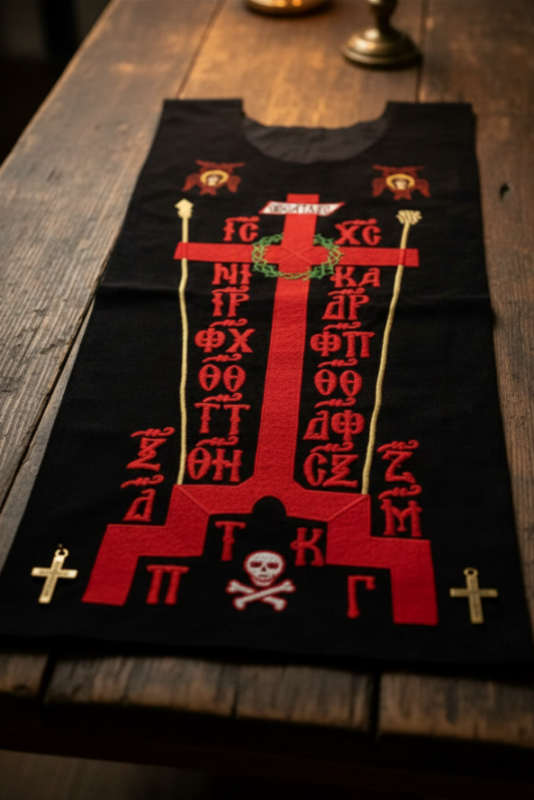
The cross of the martyrdom
In the center of the garment, there is depicted the cross of martyrdom, raised on Calvary (Golgotha), where the crucifixion took place. As mentioned in the Gospel of Matthew:
They came to a place called Golgotha (which means “the place of the skull”). There they offered Jesus wine to drink, mixed with gall; but after tasting it, he refused to drink it. When they had crucified him, they divided up his clothes by casting lots. And sitting down, they kept watch over him there. (27:33-36)
Skull and bones
At the base of the cross is placed a skull and bones, symbolizing the first man. Thus, a parallel is drawn between Adam, as the first man of the Old Testament, and Christ, who, through his incarnation and death, became the first man of the New Testament. As is characteristically mentioned in the First Epistle to the Corinthians, this is the "first" and "last Adam," the one who "lives" and the one who "gives life."
So it is written: “The first man Adam became a living being”[a]; the last Adam, a life-giving spirit. (1 Cor. 15:45)
The instruments of the Passion
To the right and left of the cross stand the instruments of the Passion. On one side there is the sponge, which they used to give vinegar to Jesus when He was thirsty, while on the other there is the spear with which they pierced His body.
Later, knowing that everything had now been finished, and so that Scripture would be fulfilled, Jesus said, “I am thirsty.” A jar of wine vinegar was there, so they soaked a sponge in it, put the sponge on a stalk of the hyssop plant, and lifted it to Jesus’ lips. (John 19:28-29)
[…] Instead, one of the soldiers pierced Jesus’ side with a spear, bringing a sudden flow of blood and water. (John 19:34)
More symbols
In addition to the above, which are the basic symbols of the great schema, there are also other designs depicted, with corresponding references to the Passion and sacrifice of the Lord. Among others, one can identify:
- The crown of thorns: as a symbol of the mockery endured by the Lord
"…and then twisted together a crown of thorns and set it on his head. They put a staff in his right hand. Then they knelt in front of him and mocked him. “Hail, king of the Jews!” they said." (Matthew 27:29)
- Hammer and nails: as the materials used in the crucifixion
"So the other disciples told him, ‘We have seen the Lord!’ But he said to them, “Unless I see the nail marks in his hands and put my finger where the nails were, and put my hand into his side, I will not believe." (John 20:25)
- Ladder: as the tool used to take Christ down from the cross
- Pillar: as the place where Pilate tied Jesus during the trial and before the crucifixion
- Rooster: as a symbol of the betrayal of Christ
"Peter replied, ‘Even if all fall away on account of you, I never will.’ ‘Truly I tell you,’ Jesus answered, ‘this very night, before the rooster crows, you will disown me three times.’” (Matthew 26:33-34)
 What do the abbreviations in the Great Schema mean?
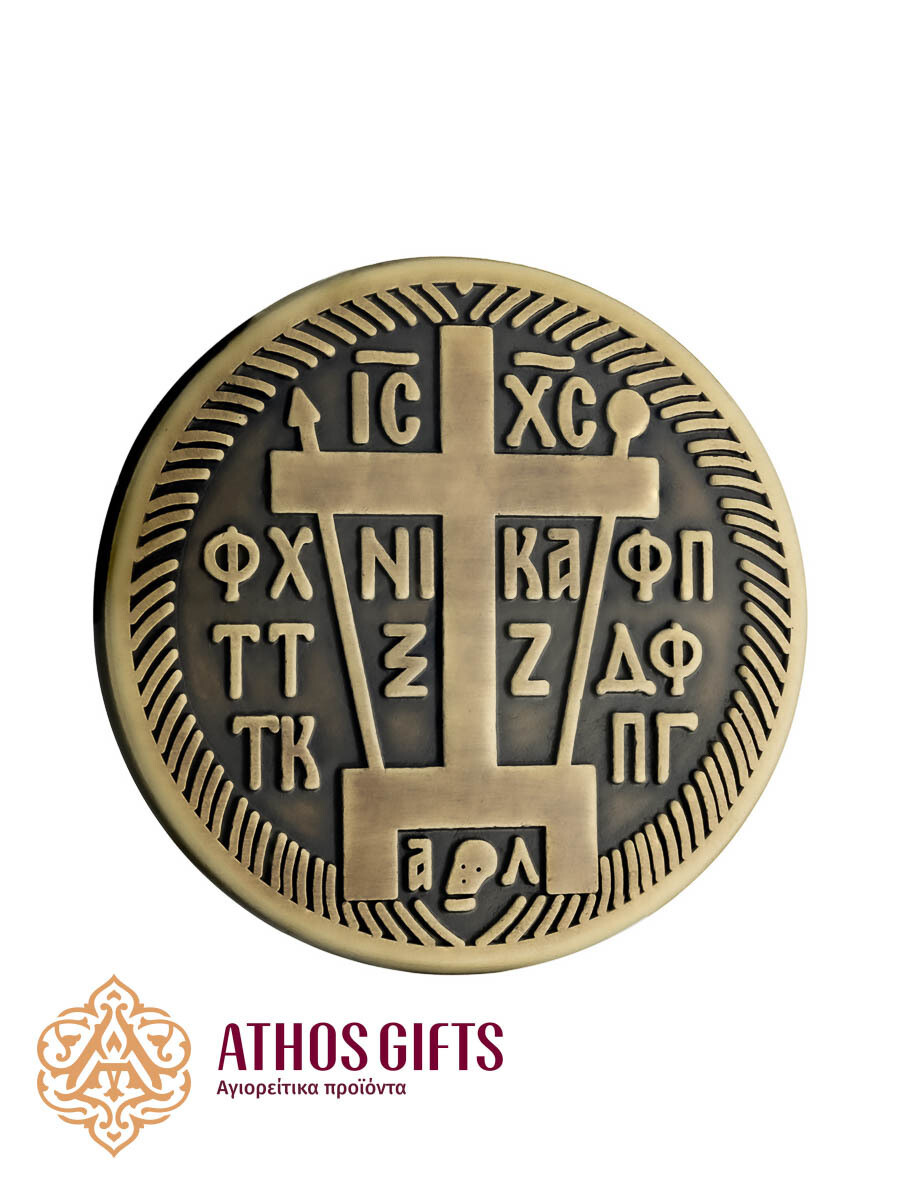
Beyond the individual designs and symbols that adorn the Great Schema, there are numerous abbreviations that frame the images and fill every empty space on the fabric. Although the inscriptions may vary depending on the extent, size, and quality of the material in question, the ones that are usually found are the following:
- ΙΝΒΙ (Ιησούς Ναζωραίος Βασιλεύς Ιουδαίων) — Jesus of Nazareth, King of the Jews
- ΟΒ ΤΔ (Ο Βασιλεύς της Δόξης) — The King of Glory
- ΙΣ ΧΣ ΝΙΚΑ (Ιησούς Χριστός Νικά) — Jesus Christ Conquers (According to tradition, the Christogram comes from a vision of Emperor Constantine, who saw a cross accompanied by the inscription "Ἐν τούτῳ νίκα" (In this, conquer). It thus became a symbol of every victory and, primarily, of the victory over death).
- ΞΖ (Ξύλον Ζωής) — Wood of Life
- ΦΧ ΦΠ (Φως Χριστού Φαίνει Πάσι) — The Light of Christ Shines Upon All (i.e., the light of Christ's grace that illuminates everything)
- ΤΤ ΔΦ (Τετιμημένον Τρόπαιον Δαιμόνων Φρίκη) — Honored Trophy of Demons Horror (the trophy refers to the cross on Golgotha, the sacred monument, which is an eternal reminder of Christ's victory over death and the salvation of man through the Divine Passion)
- ΤΚ ΠΓ (Τόπος Κρανίου Παράδεισος Γέγονεν) — Place of the Skull Became Paradise (the place of the skull refers to Golgotha, which after the sacrifice of the Lord becomes the gateway to paradise. There sin dies, Hades is abolished, and the salvation of man is accomplished).
- ΞΓΘΗ (Ξύλου Γεύσις Θάνατον Ήγαγεν) — Wood Taste Brought Death (referring to the cross of the Lord, which brought death but also His resurrection)
- CΞΖΕ (Σταυρού Ξύλω Ζωήν Εύρομεν) — Cross of Wood Life We Find (referring to the wood of the cross that saved man from original sin, abolished Hades, and opened the way to eternal life)
- ΑΔ — Adam (to the right and left of the skull at the base of the cross)
- ΤC ΔΦ (Τούτο το Σχήμα Δαίμονες Φρίττουσι) — To this Schema Demons are Frightened
- EE EE (Εωσφόρος Έπεσεν Εύρωμεν Εδέμ or Ελένης Εύρεσις Εύρωμεν Εδέμ) — Eosphorus Fell We Found Eden or Helen's Discovery We Found Eden (There are two different versions of this abbreviation. According to the first, the phrase refers to the fall of Lucifer and the ability of man to rise above sin, overcoming evil and ultimately finding paradise. According to the second version, the phrase refers to Saint Helen, who in 326 recovered the Holy Cross. With this discovery, every man can be saved, finding his Eden in paradise.)
- ΡΡ ΔΡ (Ρητορικότερα Ρημάτων Δακρύων Ροή) — Tears flow more than words (that is, more than even the most elaborate words, tears of repentance are worthy as proof of true love for God).
- ΘΘ ΘΘ (Θεού Θέα Θείον Θαύμα) — God's View Divine Miracle (the miracle of being able to see God with one's own eyes)
- ΧΧ ΧΧ (Χριστός Χριστιανοίς Χαρίζεται Χάριν) — Christ Grants Grace to Christians