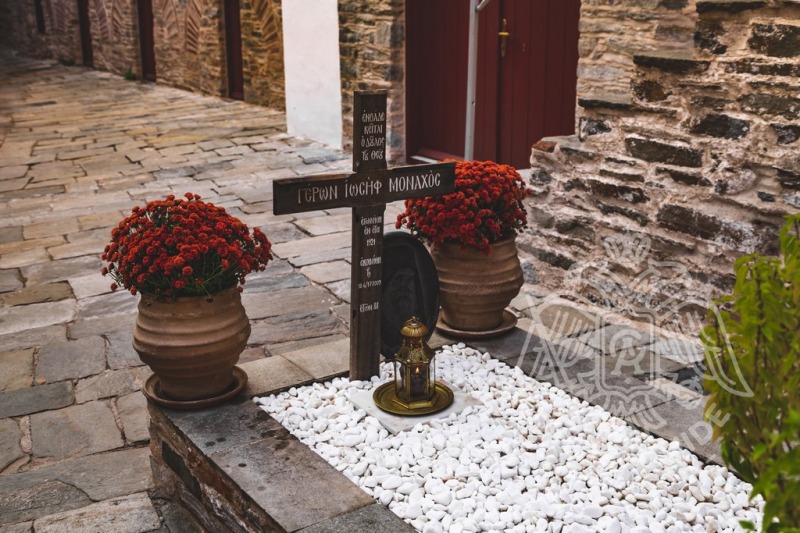
In the monasteries of Mount Athos, there are three basic stages of monastic life. At first, novice monks are introduced to the communal way of life. Then, they undergo their monastic tonsure and, at the end of their lives, the memorial service.
Through the sacrament of monastic tonsure, the monk joins the brotherhood, while through the sacrament of burial, he departs from the earthly society. Tonsure is associated with spiritual rebirth, while burial marks the decline of the flesh.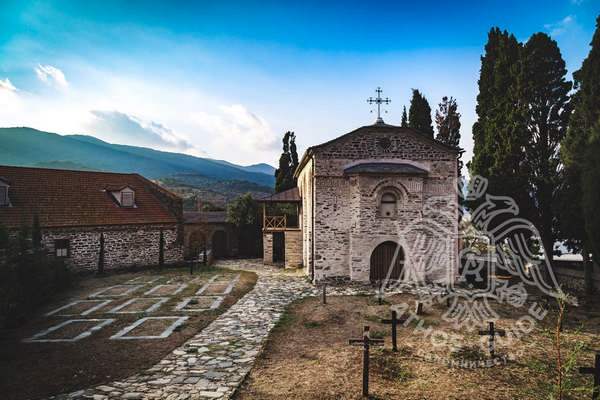
How is the body of the deceased prepared for burial in Mount Athos?
The death of a monk gets immediately known throughout the monastery and soon throughout the entire territory of Mount Athos.
Since ancient times, the ceremony of burial has been performed in Athos in the following way: after washing and taking care of the body of the deceased, clean clothes are put on the monk. The monastic habit and the polystavri are placed on the body, the hands are crossed and tied, a prayer rope is passed between them, the skullcap is put on, and the monastic hood is placed over the head. The body is placed on the bier (made of hair or wicker), after being wrapped in a strap and fitted with new shoes. The cassock is thrown over it, with its slit sleeves being placed diagonally and sewn so as to wrap the monk's body. Three crosses are sewn with white thread on the head, chest, and feet.
The deceased is ready to be transferred to the katholikon. The funeral service is held immediately after the Divine Liturgy, in the morning or after vespers, so that all the monks can accompany their brother on this last journey.
How is the memorial service performed in Mount Athos?
The memorial service is full of allegories, expressing sorrow and mourning for the passing of the deceased. The hymns do not simply refer to the futility of worldly life (which is also symbolized by the image of the deceased's body in the center of the church), but they also praise the victory of life over death, as accomplished through the incarnation of our Lord Jesus Christ.
Towards the end of the service, the monks are called upon to pay their final respects to their brother by kissing him.
Then, under the sound of the bell, his body is carried out of the church. The priests exit first, followed by the body of the deceased and the rest of the monks, holding lit candles. The entire brotherhood gathers around the tomb, where a Trisagion is performed.
Each monk prays for forty days, asking for his brother's repose. The supplications and prayers for his soul continue for a whole year in the monastery's katholikon and cemeteries, "until the complete repose of the deceased, that is, three years later."
It is remarkable that the bodies of many deceased monks of Mount Athos remain soft and flexible until the moment of their burial, unlike the bodies of all other people, which become inflexible due to their state of death.
Peculiarities of the Mount Athos tradition regarding funerals
When a monk of Mount Athos dies, his brothers do not wash his body but wipe it with a sponge dipped in warm water. In this way, they clean the forehead, chest, hands, feet, and knees.
Furthermore, the monk who dresses his brother is forbidden to look at his naked body.
If the deceased is a priest, his head is covered with the appropriate garment. If, however, the deceased was the abbot of the monastery, his head remains uncovered.
The coffin is first carried to the narthex of the church, where the monks light candles and read the psalter, each in turn.
The funeral service is performed in the narthex. If the deceased was a monk, his body is carried to the center of the main church.
During the ceremony, the brothers hold lit candles. An icon (depicting Christ the Savior and the Virgin Mary) is placed on the chest of the deceased. The service lasts much longer than the usual Divine Liturgy.
Upon arrival at the cemetery, the priest sprinkles soil and oil on the remains of the deceased, making the sign of the cross.
