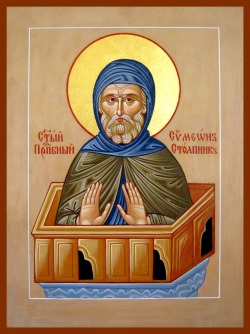
Saint Symeon the Stylite was born in Antioch of Syria in the mid-4th century. His family lived in great poverty. As a young boy he used to take care of his father’s sheep. One day, hearing the chanting coming from a church, he was deeply moved, came to love Christ, and desired to live a virtuous life. From then on, he prayed fervently to God, asking to find the path to salvation.
After experiencing a vision, he decided to become a monk. He left his family home and joined the brotherhood of a nearby monastery. Later, he withdrew into the Syrian desert, where he adopted a new form of asceticism known as stylitism. After constructing a tall pillar, he climbed onto it and made it his dwelling, renouncing rest and movement. Day and night he prayed, contemplating God while enduring every kind of hardship—rain, heat, and cold. He sustained himself on soaked grain and water brought to him by people from the surrounding area.
This form of ascetic practice became widely known across many lands. Crowds of faithful came to him from Arabia, Persia, Armenia, Georgia, Italy, Spain, and Britain. Moreover, many pagans, witnessing the strength of his spirit and hearing his teachings, converted to Christianity. Saint Symeon was granted the gift of healing both spiritual and physical illnesses, as well as the ability to foresee the future.
Emperor Theodosius II the Younger held him in great esteem and consistently followed his counsel. When Empress Eudocia was led astray by the heresy of Monophysitism, Saint Symeon persuaded her to return to the Orthodox faith, thus protecting the people from heretical influence. The new emperor, Marcian, also visited him in secret to seek his advice. At his suggestion, the Fourth Ecumenical Council was convened in Chalcedon in 451, where the false teachings of Monophysitism were condemned.
He passed away in prayer in 459. His relics are preserved in Antioch.
