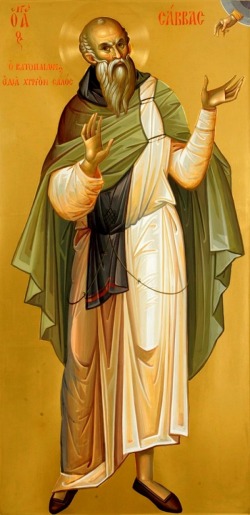
He was born around 1280/1283 in Thessalonica into a noble Orthodox family. At the age of seventeen, he secretly fled to Mount Athos and entered the Vatopedi Monastery, where he took monastic vows.
He became a disciple of an elder, who suggested that he accept the spiritual rank, but he refused, wishing to avoid honors. In 1307, during the raids on Athos, Savva was left alone and decided to make a pilgrimage to holy places, visiting many Greek islands and Cyprus.
In Cyprus, he accepted the foolishness for Christ's sake, living in complete indifference to worldly things and enduring humiliation. Once, after being beaten by the monks of a Catholic monastery, he was healed by divine light. Despite attempts to hide his holy state, his fame spread, and he decided to hide in the Holy Land.
On Mount Sinai, he spent two years as a novice, then settled in a cave in the Jordanian desert, where he continued his prayers and faced demons. He received a vision of divine light, which strengthened his spiritual life.
After four years in the desert, he returned to the monastery of Saint Savva, where he continued his ascetic feats. He then took on obedience in a communal monastery on the banks of the Jordan, where his virtues became known to other monks.
An Angel-Guardian appeared to him, commanding him to return to Byzantium to guide souls. He spent time on the island of Crete, then in Constantinople, where he hid from veneration. In the Vatopedi Monastery, he met Saint Philotheus, who became his disciple.
In 1341, during the civil war, the saint attempted to reconcile the warring sides, but unsuccessfully. He spent the last six years of his life in solitude in the Chora Monastery, praying for peace and remaining steadfast in his silence.
He passed away peacefully after 1347. His name was absent from the synaxaria, but his memory was preserved in manuscripts, as well as in the “Life” composed by his disciple Saint Philotheus Kokkinos. Monastic tradition identifies him with Saint Evdokimos, although this remains a subject of discussion.
