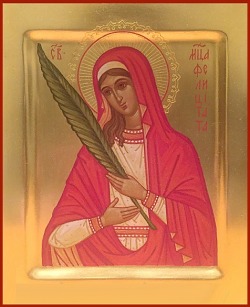
Saint Perpetua came from a noble family and lived in Carthage. Secretly from her pagan father, she received holy baptism and, despite his tearful pleas, remained steadfast in the faith. Widowed at the age of twenty-two, she cared for her nursing infant. Her brother Satyrus, the maidservant Felicitas, and the young men Revocatus, Saturninus, and Secundus were also preparing for baptism.
However, shortly before the events described, Emperor Septimius Severus issued an edict forbidding conversion to Christianity and ordering the execution of new converts. Perpetua and those of one mind with her fell under this edict, for they were catechumens.
At the beginning of 203, following a denunciation, Vibia Perpetua was seized, together with her slaves, the spouses Revocatus and Felicitas, who was pregnant at the time, and two noble young men, Saturninus and Secundus, accused of intending to become Christians. The man who instructed them in the faith, named Saturus, having learned of their arrest, voluntarily surrendered to the authorities in order to share the fate of his catechumens.
All of them were imprisoned by pagan judges. Perpetua’s father tried to shake her faith, but love for Christ was stronger.
Before her sufferings, Saint Perpetua had a vision of a golden ladder leading to heaven, with sharp objects along its sides and a terrifying serpent at its foot. Satyrus was the first to ascend the ladder, warning her about the serpent. Perpetua, without fear, stepped on the serpent’s head and saw the dwellings of paradise. This vision strengthened all the martyrs in their resolve.
After many sufferings, the saints were condemned to death. The young men were thrown to be torn apart by wild beasts, while Perpetua and Felicitas were attacked by a cow. The beasts did not touch them, and they were beheaded with swords. When Saint Perpetua was being executed, she herself brought the sword to her neck and courageously died for Christ.
