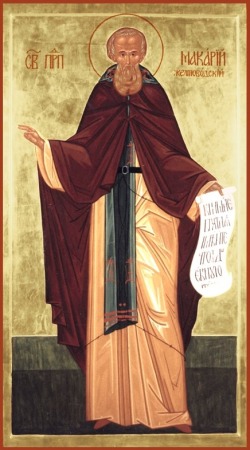
Venerable Macarius was born in 1349 in Nizhny Novgorod to pious parents who had long been childless and fervently prayed that God would grant them a child. In early childhood he would begin to weep bitterly at the first strokes of the bell calling to worship, and he would calm down only after being brought into the church, where he stood with tenderness and joy.
At the age of twelve he secretly left his parents and received monastic tonsure at the Nizhny Novgorod Pechersky monastery from Saint Dionysius. Seeking to avoid praise, the humble Macarius moved from the monastery to a modest cell near the settlement of Reshma in Yuryevets district. Before long lovers of the desert life gathered around him, and he founded for them a monastery in honor of the Theophany of our Lord Jesus Christ. His love of silence led him to leave that monastery and settle in a cave by Lake Zheltovodskoye, on the left bank of the Volga River. Yet here too brethren gathered to live with him, and around 1434 the elder founded for them a monastery in honor of the Most Holy and Life-Giving Trinity. The saint began to preach Christianity to the surrounding non-believers and baptized Muslims and pagans in Lake Zheltovodskoye.
In 1439 the monastery was ravaged by the Tatars, and the ninety-year-old Venerable Macarius was taken captive. Out of respect for his piety, the khan released the saint from captivity, and with him about four hundred Christians, on the condition that they would not settle near Lake Zheltovodskoye. Venerable Macarius buried those who had been killed and set out for the Galich region, where he founded a new monastery on the shore of Lake Unzha. He died at the age of ninety-five.
During his lifetime he healed the sick, and after his death many received healing from his relics. The monks built a church over his grave. In 1522 Tatars who tried to plunder the monastery were struck with blindness and fled. In 1532, through the prayers of Venerable Macarius, the city of Soligalich was saved from the Tatars. More than fifty people received healing from serious illnesses through the venerable one’s prayers—testimony confirmed by a commission sent by Patriarch Philaret in 1619.
