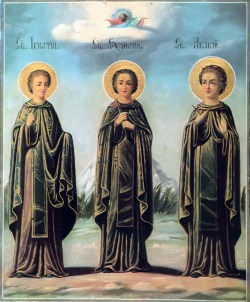
Saint Euthymius the New (whose secular name was Eleftherios) originated from Dimitsana in the Peloponnese. He was the son of wealthy and devout parents. He received his elementary education at a Greek school, studied at the Patriarchal Academy of Constantinople, and later travelled to Iași. There, he decided to become a monk and journey to Mount Athos, a plan that was thwarted by the outbreak of the Russo-Turkish War. In Bucharest, where he lived under the protection of the French consul, he abandoned himself to a sinful way of life and eventually embraced Islam.
After his circumcision, he began to suffer deep remorse. In Adrianople, he dressed in Greek clothing and attended the celebration of the Divine Liturgy. Repenting of his renunciation of Christianity, he sought refuge at the Russian embassy and from there made his way to Mount Athos, where he confessed his sins to the Patriarch Gregory V of Constantinople. Thus, his place within the Church of Christ was restored.
The saint lived in various sketes and received the monastic tonsure, taking the name Euthymius. Filled with the desire to bear witness to Christ through martyrdom, he travelled to Constantinople. There, on Palm Sunday, he stood before the Grand Vizier, Rushut Pasha, and openly denounced Islam. He was immediately arrested and subjected to severe torture. Nevertheless, he remained steadfast in his faith until he was beheaded on 22 March 1814.
The saint's body was redeemed and entrusted to the Church of the Transfiguration of the Lord. Many people were healed through his holy garments, which were stained with the blood of his martyrdom.
After the death of Saint Ignatius, the relics of both saints were transferred to Mount Athos and placed in the church. Patriarch Gregory V also erected a church in Dimitsana in honour of Saint Euthymius the New.
His memory is celebrated twice each year, on 22 March and on 1 May, together with the commemoration of the Holy Martyrs Ignatius and Acacius the New. His honourable skull is preserved in the Russian Monastery of Saint Panteleimon in Mount Athos.
