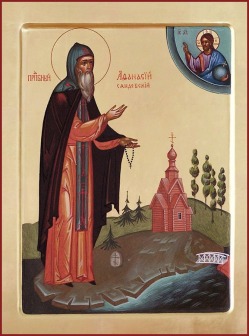
Towards the end of the 15th century, the monk Athanasius, a disciple of Saint Alexander, settled at the Monastery of Valaam. After his spiritual father withdrew to the forests of the Obonezh region, the young monk decided to follow him and live near him. There, he demonstrated great humility and obedience, while he was also blessed to witness a divine visitation of the Most Holy Theotokos.
Following the death of Saint Alexander in 1533, Athanasius withdrew to the forests of Karelia, where he founded a hermitage. Many devout brethren soon joined him there. He built a chapel dedicated to the Holy Trinity, along with eight cells. However, due to the envy of certain people, he was eventually forced to leave the monastic community.
He then went to the Monastery of Svir, where he was elected abbot. In 1577, he received permission to establish a monastery and a church dedicated to the Holy Trinity, following the principles of monastic life that he had practised in his last brotherhood.
Saint Athanasius often conversed with Saint Adrian of Andrusov, who had also founded a monastery on the shores of Lake Ladoga. According to tradition, Athanasius foretold the establishment of a church in the village of Tuloksa, where the Church of Saint Nicholas now stands.
During the final years of his life, the saint lived in solitude on one of the islands of Lake Siandem. He reposed in his hermitage and was buried on the peninsula of Lake Roshchinskoye, where a church dedicated to Saints Cyril and Athanasius was later built.
At the beginning of the 17th century, the invasion of the Lithuanians and Swedes destroyed all written records concerning his life. In the 18th century, the Siandem Hermitage was destroyed by fire. However, the church was restored in 1720.
The area is surrounded by coniferous forests, with the wooden Church of the Dormition of the Mother of God standing prominently among them.
The holy relics of Saint Athanasius were later discovered incorrupt.
His memory is celebrated on 18/31 January and 2/15 May.
