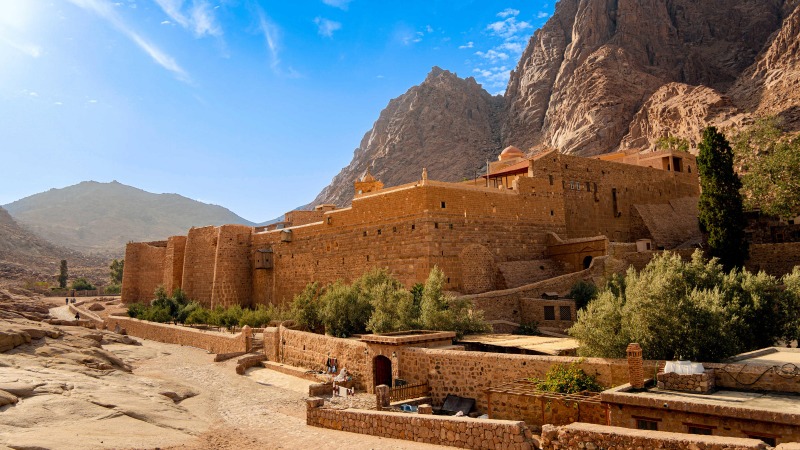
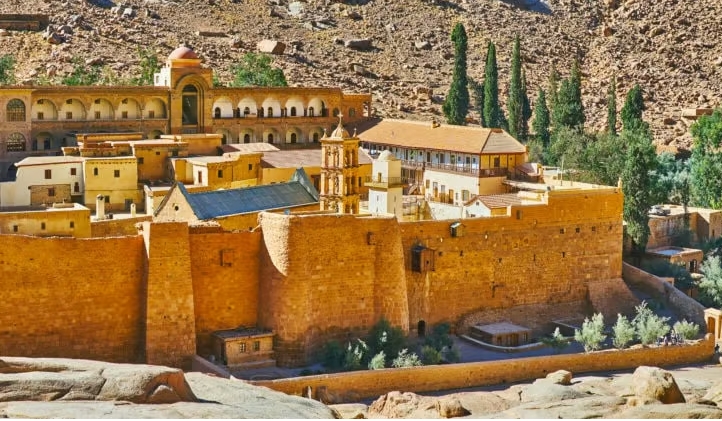
The Holy Monastery of Sinai, dedicated to Saint Catherine, is one of the oldest and most revered Christian monastic institutions in the world. Its significance is immense, not only for the history of the Orthodox Christianity but also for our shared global cultural heritage. In addition to being a place of Orthodox worship, it is a UNESCO World Heritage Site, a designation that affirms its profound historical and cultural value.
The recent decision by the Egyptian authorities to recognize the monastic grounds as an Egyptian state property, has sparked strong reactions from both the Orthodox Church and the Greek state. It has also raised serious concerns about the future of the monastic community that has preserved this sacred site for centuries.
.jpg) It is a complex and multifaceted issue, which can be approached from religious, cultural, legal, and diplomatic perspectives.
It is a complex and multifaceted issue, which can be approached from religious, cultural, legal, and diplomatic perspectives.
- What is the history of the Sinai Monastery?
- What is its significance to the world’s cultural heritage?
- What are the possible consequences of the Egyptian State’s decision?
Historical Background
The Monastery of Saint Catherine at Mount Sinai was founded between 527 and 565 AD by the Byzantine Emperor Justinian I. It was built on the very site where, according to the Old Testament, Moses received the Ten Commandments, a location of immense spiritual and historical significance. Before the foundation of the monastery, a chapel known as the Chapel of the Burning Bush had already been erected on the site by Saint Helen, the mother of Emperor Constantine the Great. Emperor Justinian's intention in constructing the monastery was to enshrine and protect this sacred ground, highlighting the miraculous biblical event associated with it.
The monastic life in the Sinai region, however, predates Justinian’s foundation. As early as 381–384 AD, small communities of Christian ascetics had settled in the area, drawn by its spiritual resonance and isolation. The formal establishment of the monastery in the 6th century was originally in honor of Theotokos of the Burning Bush. It was not until the 9th century that the monastery was dedicated to Saint Catherine. According to tradition, the saint’s relics were miraculously transported to the site, so that she came to be venerated as its heavenly patron and protector.
In 2002, the monastery complex, its architecture, its artistic treasures, and surrounding natural landscape, was inscribed on the UNESCO World Heritage List. This designation affirmed its standing as one of the world’s most important monuments of cultural, religious, and historical value.
The Question of Autonomy
.jpg)
The Monastery of Saint Catherine has historically operated with a high degree of autonomy, functioning as a self-governed monastic community with its own property and internal administrative structures. It is part of the autonomous Church of Sinai, which also includes the various dependencies of the monastery located throughout the Sinai peninsula and other regions of Egypt.
The Ecumenical Patriarchate of Constantinople formally recognized the autonomy of the Church of Sinai in 1575. This recognition was reaffirmed in 1782 through a sigillion issued by the Patriarch Gabriel IV. According to the ecclesiastical tradition, the Archbishop of Sinai serves as the head of this autonomous church body.
The current dispute centers on the autonomy of the monastery, its property rights, and its status as a place of worship. The roots of the issue trace back to 2014, when the Muslim Brotherhood initiated legal proceedings challenging the monastery’s ownership of its land and property in the surrounding area.
Once the legal status of the monastery came under scrutiny, bilateral negotiations were initiated between the Greek and Egyptian governments with the goal of reaching an out-of-court settlement. Despite a series of agreements reached, on May 28, an Egyptian court issued a ruling that was widely interpreted as recognizing the monastery as state property.
If made, such a decision undermines the monastery's autonomous ecclesiastical governance by classifying it as a state institution. As such, the monastery will then be considered state territory subject to Egyptian state administration and cultural heritage legislation.
The news raised serious concerns not only about the future of monastic life in Sinai, but also about broader issues of religious freedom, cultural heritage preservation, and international church law. The reaction of Christian communities worldwide was immediate, resulting in an official statement from the Egypt’s State Information Service made the next day.
It argued that the ruling "represents the first instance in which the legal status of the monastery has been regulated, with a clear affirmation of the preservation of its sacred standing", and that the court also affirmed the monks’ continued right to benefit from additional sites classified as natural reserves, as well as local religious and archeological sites. It also stated that the court's decision is concerned with some uninhabited areas distant from the monastery, in regards to which there are no ownership records, so consequently, these lands are considered state property.
However, the 160-page ruling, which includes not only titles and explanatory opinions, but also extremely complex legal reasoning in the Arabic language, is of such complexity that even legal professionals struggle to grasp it fully, and therefore it continues to cause concern. Nikos Meletis, a columnist for the Greek news outlet Proto Thema, suggests that by stressing its intention to respect "the religious character and sanctity" of the monastery, the Egyptian side tries to move the discussion away from property ownership rights.
Reactions to the Latest Decisions
The decision has immediately sparked a wave of reactions, both from the Church of Greece and from the Greek state.
Reaction of the Church of Greece
The response from the Archbishop of Athens and All Greece, Ieronymos II, was immediate and forceful. In a public statement, he denounced the ruling as a “violation of human and religious freedoms” and called for UNESCO to intervene in defense of the monastery’s spiritual and cultural identity. The archbishop emphasized the role of the international community in safeguarding the monastery's unique heritage and religious function.
In his official statement, he declared:
"Following yesterday’s scandalous decision by the Egyptian judicial authorities (a shameless violation of human rights, and especially religious freedoms) the world’s oldest Orthodox Christian monument, the Holy Monastery of Saint Catherine on Mount Sinai, now faces a severe trial reminiscent of some of the darkest times in history.
Despite the recent assurances from the Egyptian President to the Greek Prime Minister, the Egyptian government has chosen to disregard justice entirely and is effectively attempting to erase the very existence of the Monastery. This threatens its entire operation, including its devotional, spiritual, and cultural mission.
The Monastery’s property is being unlawfully seized and confiscated, and this spiritual beacon of Orthodoxy and Hellenism now confronts a critical threat to its survival.
With deep sorrow and justified anger, I call upon every Greek and international authority to recognize the grave matters involved and to act immediately to protect the fundamental religious freedoms of the Holy Monastery of Sinai.
I unequivocally condemn any effort to alter the status quo that has governed this sacred site for fifteen centuries. I appeal to the responsible Greek Government, and personally to the Prime Minister Kyriakos Mitsotakis, to take quick action to restore lawful order and ensure the Monastery is preserved.
I wholeheartedly express my fraternal solidarity with the Brotherhood and its Abbot, His Eminence Archbishop Damianos of Sinai and Raitho, as well as with the Greek brothers who serve sacrificially throughout the wider Sinai region.
Finally, I neither want to believe nor can I accept that today Hellenism and Orthodoxy are facing yet another historic “fall.”
This is something we cannot and must not allow.”
The Position of the Greek Government
The Greek Ministry of Foreign Affairs expressed its deep disappointment following the ruling of the Egyptian court, emphasizing that there had been clear bilateral agreements regarding the status of the Monastery of Saint Catherine, agreements which, regrettably, were not honored by the Egyptian side. According to government sources, Greece intends to employ all available diplomatic means to restore the monastery’s historical and religious status.
Greece’s foreign minister Giorgos Gerapetritis will reportedly lead a delegation traveling to Cairo June 4. The involvement of such a high-ranking figure suggests the Greek government is serious about defending the monks’ rights.
The Importance of the Monastery
The Monastery of Saint Catherine is not merely a place of worship, it is a universal cultural symbol that has preserved its identity unaltered for centuries. It embodies memory, tradition, and the peaceful coexistence of cultures and religions, standing as a cornerstone in the shared historical heritage of humanity.
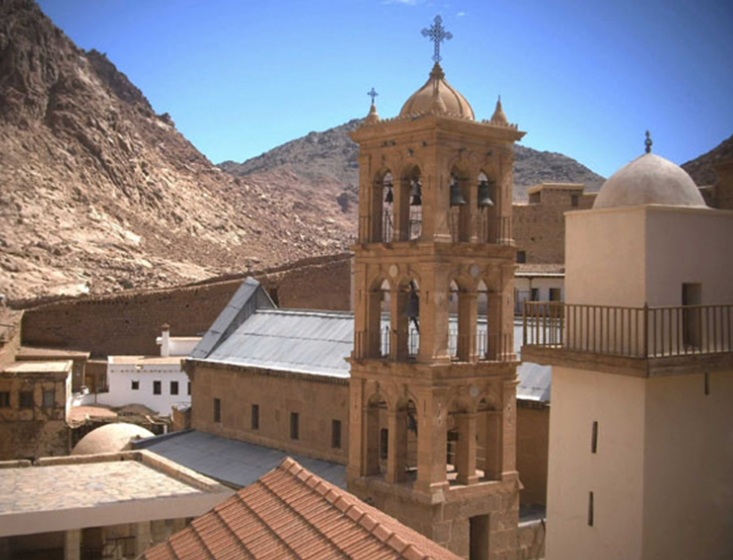 When the monastery was inscribed on the UNESCO World Heritage List in 2002, its global significance was assessed on the basis of three fundamental criteria:
- Spiritual and religious significance: The Monastery is a sacred site for three major world religions, Christianity, Judaism, and Islam, which all recognize the importance of Mount Sinai in their respective traditions.
- Historical and artistic importance: As a continuously active monastic community for nearly 1,500 years, the Monastery has amassed a remarkable collection of ancient manuscripts, icons, relics, and works of art of inestimable historical and cultural value.
- Symbol of coexistence: Located in the heart of a geopolitically unstable region, the Monastery has for centuries been a beacon of peace and tolerance, serving as a monument of interreligious coexistence.
Considering these factors, the recent decision of the Egyptian court is not merely a matter of concern for the monks of Sinai or the Orthodox Church. It is a decision that affects all humanity. It intervenes in and alters the status of a living institution, a unique and irreplaceable center of spiritual, cultural, and historical continuity, a treasure of civilization that belongs to everyone, regardless of origin, nationality, or religion.
The crisis surrounding the Monastery of Saint Catherine is not a merely local or religious issue. It serves as a stark reminder of the delicate and often precarious balance between state sovereignty, human rights, and the preservation of global cultural heritage.