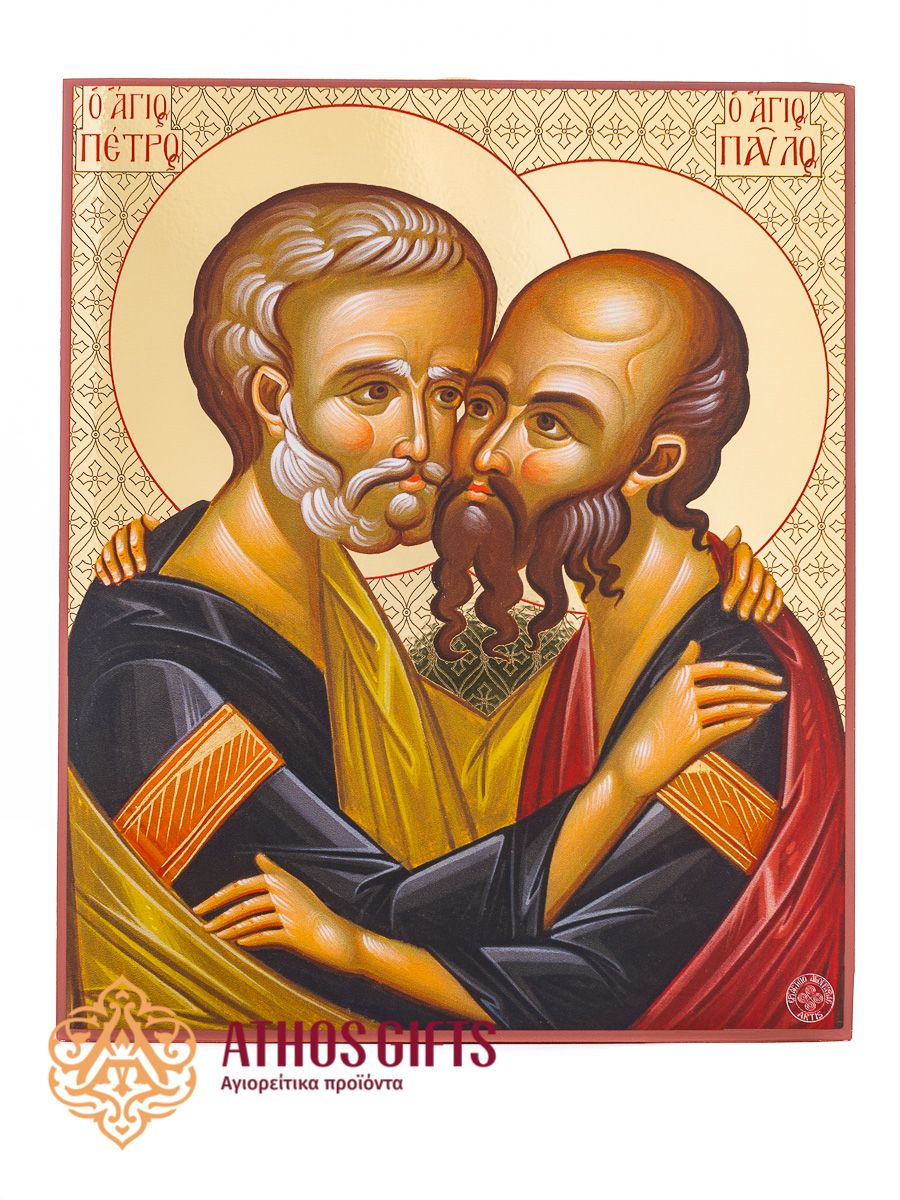
Saints Peter and Paul were called by Christ to preach the Gospel, spreading throughout the world the message of love and salvation for the humankind. Together, they stand as powerful examples of sincere repentance and return to the Lord. At the same time, they are living testimonies to the forgiveness and compassion of God.
Apostle Peter
Before meeting Christ, who gave him the name Peter, the saint was known as Simon. He was born in Bethsaida of Galilee. His father’s name was Jonah. His brother was Andrew the Apostle, who introduced him to Jesus, saying: “We have found the Messiah” (John 1:41).
Simon Peter was married and worked as a fisherman. He loved the sea and took pride in earning his bread through hard work. His profession taught him perseverance, patience in times of failure, and gratitude in times of abundance. He was a dynamic, genuine, and honest man.
His encounter with Jesus transformed his life forever. From an ordinary fisherman, Christ made him a “fisher of men,” an apostle called to gather believers and prepare them for the Kingdom of Heaven. Peter proclaimed the message first preached by John the Baptist and confirmed by Christ Himself: “Repent, for the kingdom of heaven has come near” (Matthew 3:2).
Apostle Peter was raised in the Jewish faith inherited from his family. He grew up in the synagogue and within the Jewish and partially Hellenistic environment of Galilee, where many religions coexisted. Although he was a simple man and did not speak Greek fluently, he was accompanied by Mark the Evangelist, his disciple and interpreter, who translated many texts for him from Hebrew into Greek.
Apostle Paul

The Apostle Paul was originally named Saul. He was born in Tarsus of Cilicia, since his family had been exiled by the Romans. He was highly educated in theology, having studied in Tarsus and Jerusalem. Paul was also a Roman citizen with a cosmopolitan background, spoke Greek, and had been a student of Gamaliel, a renowned scholar of the Law of Moses.
Although Paul lived during the time of Jesus, the two never met during Christ’s earthly life. According to tradition, Saul fiercely persecuted the early Christian community. During these persecutions in Syria, while traveling near Damascus, he experienced a life-changing encounter with Christ, who appeared before him and said: “Saul, Saul, why do you persecute me?” (Acts 9:4).
At that moment, Saul realized that Christ was the true Messiah. He recognized Him as the head of the Church and devoted his life to serving Him.
Though Saul had once pursued Christians with hatred, the grace of God sought to save not only the believers but also their persecutor. After his conversion and baptism, Saul became the Apostle Paul, the most fervent missionary of Christ and of His Church.
The Two Apostles of the Lord
Born in different lands and cultures, shaped by different educations and ways of life, Saints Peter and Paul were both called to become apostles of the Gospel. Each fulfilled a unique mission: Saint Peter preached primarily to the Jews, while Saint Paul carried the Gospel to the Gentiles and nations of the world. Saint Peter is counted among the Twelve Apostles, while Saint Paul is often regarded as the Thirteenth Apostle.
What Do Saints Peter and Paul Have in Common?
The Apostles Peter and Paul shared a profound experience of true faith and spiritual strength. Both were filled with a living love for Christ, receiving the grace and enlightenment of His divine presence.
Saint Peter confessed the divinity of Jesus, declaring: “You are the Messiah, the Son of the living God” (Matthew 16:16), while the Apostle Paul proclaimed that in Christ “all the fullness of the Deity lives in bodily form” (Colossians 2:9).
Through their words and teachings, the world came to know the Christian faith, within which there lies the full mystery of God’s truth. As the sacred writings of the Church proclaim: “Beyond all question, the mystery from which true godliness springs is great: He appeared in the flesh…” (1 Timothy 3:16).
Both apostles experienced repentance, transformation, and renewal in their lives. Saint Peter denied Christ three times (Luke 22:62), yet he remained devoted to Him until his martyrdom. Saint Paul once persecuted the Church, but after his conversion he became one of its greatest servants, dedicating his life to the ministry of the Gospel.
Ultimately, what united these two saints was their love for Christ and His flock. The Church is founded upon the rock of faith. As Saint Peter confessed, Christ is the cornerstone who unites both the Jewish people and all nations within the body of the Church. Peter worked tirelessly for the preservation of the true faith and the unity of the Church, rejecting false prophecies and misleading teachings that sought to deceive the faithful.
“But there were also false prophets among the people, just as there will be false teachers among you. They will secretly introduce destructive heresies, even denying the sovereign Lord who bought them—bringing swift destruction on themselves. Many will follow their depraved conduct and will bring the way of truth into disrepute. In their greed these teachers will exploit you with fabricated stories. Their condemnation has long been hanging over them, and their destruction has not been sleeping.
For if God did not spare angels when they sinned, but sent them to hell,[a] putting them in chains of darkness[b] to be held for judgment; if he did not spare the ancient world when he brought the flood on its ungodly people, but protected Noah, a preacher of righteousness, and seven others; if he condemned the cities of Sodom and Gomorrah by burning them to ashes, and made them an example of what is going to happen to the ungodly; and if he rescued Lot, a righteous man, who was distressed by the depraved conduct of the lawless (for that righteous man, living among them day after day, was tormented in his righteous soul by the lawless deeds he saw and heard)— if this is so, then the Lord knows how to rescue the godly from trials and to hold the unrighteous for punishment on the day of judgment. This is especially true of those who follow the corrupt desire of the flesh[c] and despise authority.
Bold and arrogant, they are not afraid to heap abuse on celestial beings; yet even angels, although they are stronger and more powerful, do not heap abuse on such beings when bringing judgment on them from[d] the Lord. But these people blaspheme in matters they do not understand. They are like unreasoning animals, creatures of instinct, born only to be caught and destroyed, and like animals they too will perish.
They will be paid back with harm for the harm they have done. Their idea of pleasure is to carouse in broad daylight. They are blots and blemishes, reveling in their pleasures while they feast with you. With eyes full of adultery, they never stop sinning; they seduce the unstable; they are experts in greed—an accursed brood! They have left the straightway and wandered off to follow the way of Balaam son of Bezer, who loved the wages of wickedness. But he was rebuked for his wrongdoing by a donkey—an animal without speech—who spoke with a human voice and restrained the prophet’s madness.
These people are springs without water and mists driven by a storm. Blackest darkness is reserved for them. For they mouth empty, boastful words and, by appealing to the lustful desires of the flesh, they entice people who are just escaping from those who live in error. They promise them freedom, while they themselves are slaves of depravity—for “people are slaves to whatever has mastered them.” If they have escaped the corruption of the world by knowing our Lord and Savior Jesus Christ and are again entangled in it and are overcome, they are worse off at the end than they were at the beginning. It would have been better for them not to have known the way of righteousness, than to have known it and then to turn their backs on the sacred command that was passed on to them. Of them the proverbs are true: “A dog returns to its vomit,” and, “A sow that is washed returns to her wallowing in the mud.”
(2 Peter 2:1-22)
During the persecutions unleashed by the Emperor Nero in 67 AD in Rome, the Saints Peter and Paul became martyrs of the faith.
The Preaching of the Gospel in Europe
What Was Europe Like During the Time of the Apostles Peter and Paul?
At that time, paganism and polytheism were widespread in Europe.
The apostles had to confront the pride of Greco-Roman philosophy, which struggled to accept the Passion and Resurrection of Christ, the humble love of the Almighty God, and the promise of eternal life. The fear of death held the ancient world in spiritual bondage: “and free those who all their lives were held in slavery by their fear of death” (Hebrews 2:15).
For many people, to believe in a God who was not subject to death, but who conquered death itself, became a true source of liberation and hope.
The apostles’ mission was also met with hostility from political authorities. Although Saints Peter and Paul repeatedly encouraged respect toward imperial, civil, and military authorities through their epistles, they never equated the Roman Empire with the Kingdom of Heaven, nor the emperor with the eternal living Lord. This was precisely why they were persecuted, until they ultimately became martyrs for Christ.
Why Do We Turn to the Saints Peter and Paul for Help?
Saints Peter and Paul are honored as the first teachers and preachers of Christian faith. They are models of missionary service and heralds of the life and unity of the Church.
Through their lives, works, and sacred writings, they teach us to love Christ, to honor the Gospel, and the Church; to pray for the healing and salvation of all people regardless of race, gender, nationality, or social status; and to live with faith, forgiveness, reconciliation, and holiness.
For Christians, they stand as enduring examples of unity and spiritual transformation. They teach us to hope without ceasing, to labor in good works pleasing to God, and not to place our trust in mortal life alone. Instead, they encourage us to rely on the grace of the living God, revealed through Jesus Christ for the salvation of humanity.
Orthodox Christians fervently pray to the Apostles Peter and Paul, asking for their intercession and help in every difficulty or hardship.
Prayer to Saints Peter and Paul
Troparion
O foremost of the Apostles and teachers of the inhabited earth, / intercede with the Master of all / to grant peace to the world and great mercy to our souls.
Kontakion
You received the steadfast and divinely-inspired Heralds, O Lord, the Foremost Apostles, / for the enjoyment of Your blessings and repose. / For You recognized their labors and death as greater than any burnt offering, / for You alone know what is in the hearts of men.
The Icon of the Saints Peter and Paul
In the Orthodox iconography, there are two traditional depictions of Saints Peter and Paul. In the first, the two apostles are shown facing forward, holding between them the Church of Christ. In their hands they carry the Word of God, as preserved in the Epistles, the sacred texts, and the Gospel.
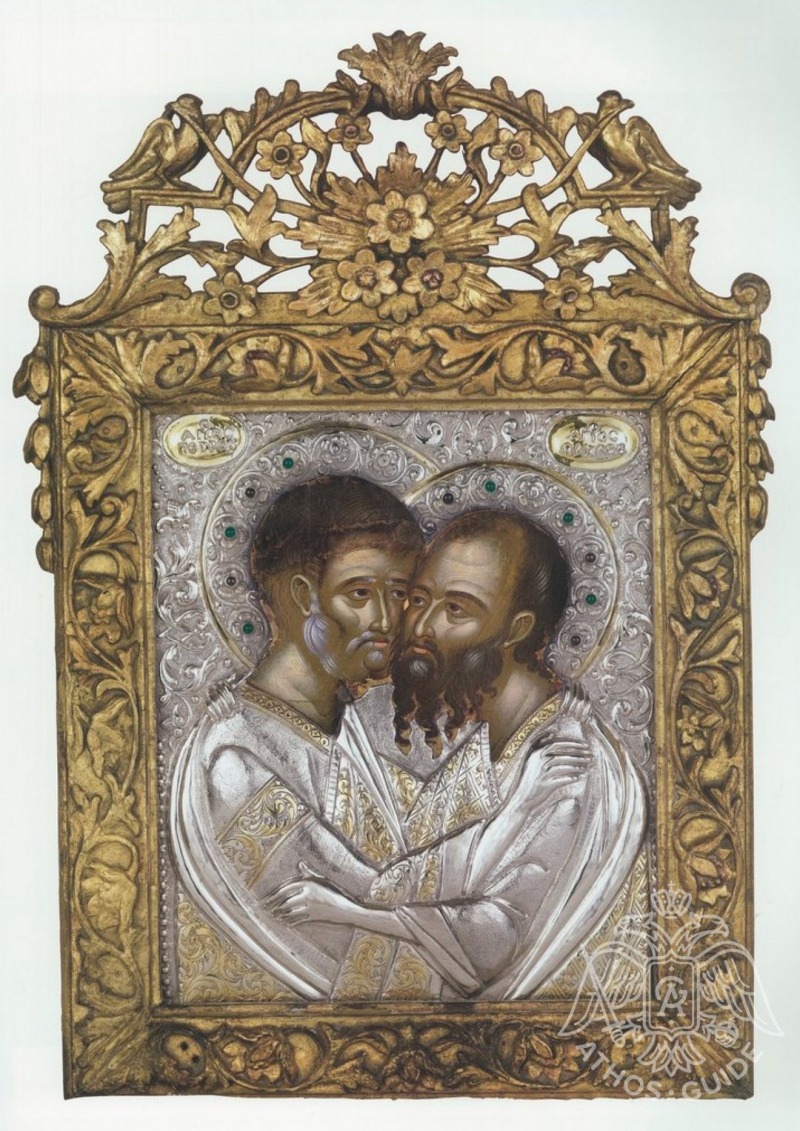
In the second iconographic type, the two saints are depicted embracing one another. Their faces touch, symbolizing their mutual love, unity, and devotion in Christ.
A sacred and miraculous icon of Saints Peter and Paul is preserved in Mount Athos at the Monastery of Karakallou.