The 12 Invisible Ascetics of Mount Athos
According to tradition, 12 invisible ascetics dwell at the summit of Mount Athos.
They live near the peak of the mountain throughout the entire year, sustaining themselves solely through prayer, continually repeating the words:
“Lord Jesus Christ, Son of God, have mercy on me, a sinner.”
When one of them falls asleep in the Lord, another immediately takes his place. Therefore, their number remains always the same.
.jpg)
The Last Divine Liturgy Before the Final Judgment
The Athonite fathers believe that before the Second Coming of Christ and the Final Judgment, the invisible monks will celebrate the last Divine Liturgy of the world, in the Church of the Transfiguration of the Lord at the summit of Mount Athos.
Although they reside there, there are numerous testimonies of people who have encountered them in different parts of the peninsula.
They are considered among the most holy and ascetic figures of Mount Athos. Many pilgrims and monks have reported that while walking through the Athonite land or during prayer, they felt a continuous presence of somebody standing beside them. Some believers even claim they were granted the grace to see an invisible elder and speak with him.
Saint Paisios and the Invisible Ascetics
Saint Paisios of Mount Athos have also spoken about the invisible hermits. In 1950, when he first arrived at Mount Athos, he lost his way while walking from Kausokalyvia toward the Skete of Saint Anne.
As he later recounted:
“I was going toward the Skete of Saint Anne but instead took the path leading to the summit of Mount Athos. I was searching for my way back and praying to the Virgin Mary for help, when suddenly a hermit appeared before me. His face was shining with light. He looked about seventy years old. However, from his clothing it was clear that he had never lived among people.
He wore a very worn and tattered cassock made of gauze, with holes tied together using small wooden sticks. He carried an old leather bag, also torn. Around his neck he wore a heavy chain with a small box attached, as if it contained a holy relic.
Before I could speak, he said: ‘My child, this path does not lead to Saint Anne,’ and showed me the correct direction. It was clear to me that I was standing before a saint.
I asked him, ‘Where do you live, elder?’ And he replied, ‘Here,’ pointing toward the summit of Athos.
Suddenly I lost all sense of time. I had forgotten the day and month. I asked him, and he told me it was Friday. Then he took out a small leather case with wooden markers, examined them carefully, and gave me the exact date. After receiving his blessing, I followed the path he indicated, which led me directly to Saint Anne.
Later, when I learned that twelve hermits (or seven, as some people claim) lived on the summit of Athos, I wondered whether that man was one of them. When I shared my experience with the elders, they confirmed: ‘Yes, he must have been one of the venerable monks who live on the mountain’s peak.’”
The Story of a Young Ascetic
Saint Paisios of Athos also used to tell the story of a young ascetic.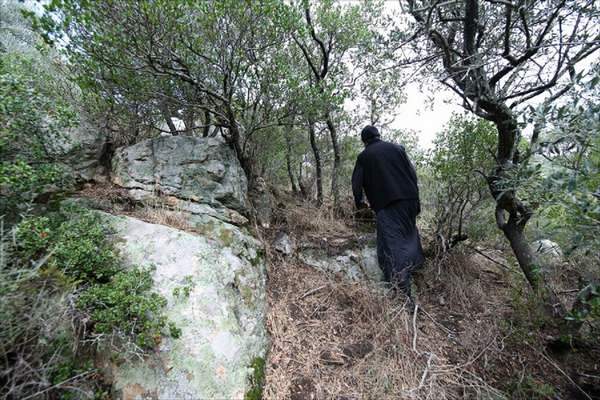
A man from Athens, born into a wealthy family, lost his parents, distributed his inheritance to the poor, and went to Mount Athos.
Passing through the New Skete, he met Father Neophytos, who lived in the hut of Saint Demetrios. He stayed there and regularly confessed to the elder, who told him many stories about the ascetics of Athos.
When the young man heard about the hermits, a deep desire was born within him to become one of them. Father Neophytos refused to tonsure him as a monk for five years, helping him grow spiritually instead. During this time, no one knew about his deep desire, as he spoke to no other monks.
After completing this period of preparation, he was tonsured and given the name Seraphim. He then received the blessing to live an ascetic life high on Mount Athos, avoiding all human contact.
Three years later, he returned to the hut and spoke about the intense spiritual struggles he had endured and the demonic attacks he had to face.
Five years later, the monk Seraphim returned once more. Father Neophytos gave him a reliquary containing the Holy Gifts. After this, he withdrew again to the summit of Athos and was never seen again.
Conclusion
The 12 invisible monks of Mount Athos are considered holy figures of great spiritual grace. Their presence on the Holy Mountain is seen as a supreme blessing. They are regarded as guardians of the monastic community and helpers of all Christians, as through their hidden asceticism and constant prayer they remain spiritually close to all who are in need.
Their spiritual strength transcends natural order, while their deep humility and love for Christ transform them into angelic presences.