How Did the Prohibition in Mount Athos Begin?
Mount Athos is located on the peninsula of Chalkidiki. Its highest peak reaches 2,033 meters. Since the establishment of the Athonite monastic state—which, according to Article 105 of the Greek Constitution, constitutes a self-governed part of the Greek State—the entry of women has been prohibited. It is considered the largest area in the world where there is applied such a restriction.
The regulation, known as the “Avaton,” is traditionally traced back to the era of the Byzantine Emperor Justinian. It was officially institutionalized in 539 AD.
Therefore, when the first monasteries were founded on the peninsula, the Avaton had already been formally established as a rule excluding women. At that time, the restriction was so strict that it extended even to female animals, such as hens. This forced monks to buy eggs from the nearby regions.
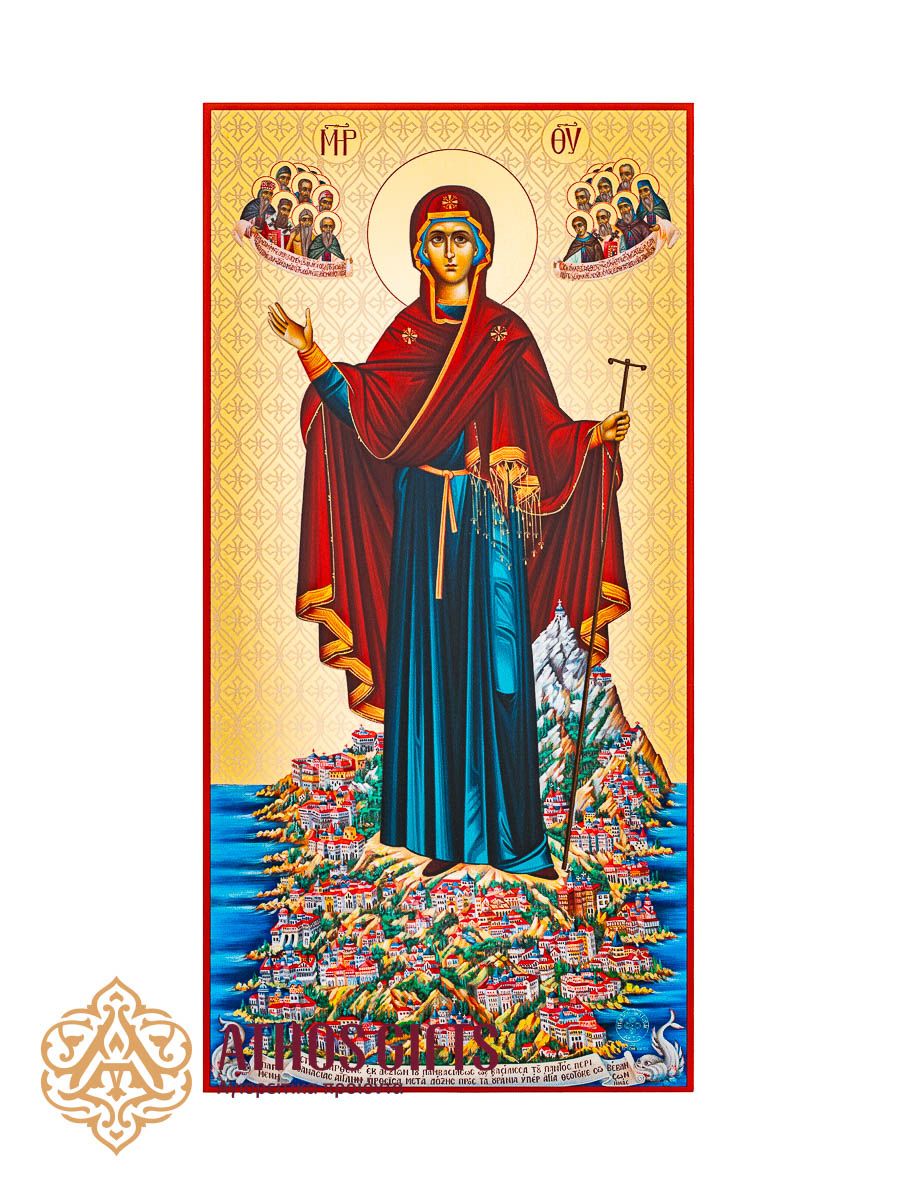
According to the ascetics of the monastic community, the Virgin Mary herself protects Mount Athos, punishing those who violate its boundaries.
Mount Athos is regarded as “her garden.” According to tradition, after the Ascension of Christ, the Virgin Mary was invited by Lazarus, the brother of Martha and Mary, to visit the Church of Cyprus. During the journey, the ship carrying her was driven off course by strong winds. She, together with Saint John the Theologian, eventually arrived at the eastern coast of the peninsula, near the present-day Monastery of Iviron. At that time, the site of the monastery housed a pagan temple and the oracle of Apollo.
Enchanted by the beauty of the place, she fell to her knees and prayed to her Son and God to grant her this land as a holy garden. Her prayer was answered, and thus Athos was dedicated to the Mother of God, who blessed the peninsula and its inhabitants.

Women Who Entered Mount Athos
Mount Athos continues today to be regarded as a place dedicated to the Virgin Mary. She is considered its “queen” and the only female presence on the peninsula.
There are, however, several notable stories connected to Mount Athos and to the history of the Avaton. One striking example concerns a monk who was born within the Athonite territory, lived his entire life there, and passed away in 1978. His mother is said to have in some way entered the monastic state and gave birth to him while on Mount Athos.
As monks themselves acknowledge, the gates of Athos have occasionally been opened in exceptional circumstances, allowing entry to the civilian population during times of war, when people’s lives were at risk.
There are also numerous narratives and legends surrounding the same prohibition. During the Ottoman period, it is said that Ottoman soldiers once attempted to enter the peninsula accompanied by their wives. They also presented documents signed by local authorities. According to the tradition, one of the soldiers suddenly collapsed and died. The monks report that the Ottomans, who had previously mocked the Avaton, panicked, asked for forgiveness, and left the peninsula in repentance. The body of the dead soldier was buried, but later washed into the sea by heavy rain.
Officially, there have been recorded twelve violations of the women’s entry prohibition on Athos.
The first recorded case dates back to 382 AD, involving Placidia, daughter of the Emperor Theodosius, at a time when an organized monastic state did not yet exist. Much later, in 1081 and 1108, further incidents occurred involving hundreds of shepherd families.
In 1345, Helena, the wife of the Serbian Emperor Stefan Dušan, visited the Serbian Monastery of Hilandar. In 1404, the wife of John Palaiologos visited the Monastery of Great Lavra. In 1850, the British ambassador to Constantinople, Stratford Canning, visited Athos accompanied by his wife.
Monks vividly describe the feast organized in her honor, which later sparked controversy, leading to an official response from the Church calling for measures to ensure that such incidents would not be repeated.
In 1854, the Avaton was likewise violated by a group of women and children seeking refuge during the military operations in the region of Chalcidice.
The Greek Aliki Diplarakou was also among those who crossed the boundaries of Athos. In 1930, at the age of 18, she represented Greece in the European Beauty Contest in Paris, where she was crowned Miss Europe. A few months after her victory, she became the subject of media attention again for entering Mount Athos in disguise as a sailor while aboard a yacht.
Shortly afterward, she fell seriously ill and was hospitalized in Switzerland. She wrote a letter to the abbot of the Monastery of Dionysiou, expressing deep remorse and linking her sudden illness to her violation of the Athonite rule.
In her letter she stated:
“In Davos, Switzerland,
Reverend Fathers, I confess with all my heart the mistake I committed last May at the Monastery of Vatopaidiou… I arrived there by the ship of my fiancé Mr. Moran. The ships Limnos and Kilkis were happened to also have anchored there. The thought came to me—against my judgment—to enter the monastery, although I knew it was forbidden. Borrowing a naval uniform, I entered with my fiancé, toured churches and other places disguised as a sailor, without being recognized… Since then, dear Fathers, I have lost my health and I am here in sanatoriums in Switzerland without any improvement. I have come to believe that this is a punishment from the Virgin Mary, whom I have disrespected. I now repent and ask for forgiveness… Pray as well, my dear fathers. To this end, please also accept 5,000 drachmas, so that you may perform liturgies and supplications for my health.”
.jpg)
In 1948, a group of women who had been driven away from their homes during the Greek Civil War ended up on Mount Athos. According to the testimony of 17-year-old Eugenia Peggiou, given many years later:
“I committed a sin. I was very afraid. My group arrived at the Monastery of Iviron. The monks did not open the gate. A soldier forced his way into the monastery and opened the doors. I did not go inside. I was standing outside with a gun in my hand.”
According to other accounts, Jacqueline Kennedy also arrived at the coast of the Monastery of Great Lavra together with Aristotle Onassis. Her visit reportedly ended unexpectedly after she injured her ankle, leading to her immediate return to the yacht.
Visitors Regulation in Mount Athos
Only 100 Orthodox and 10 non-Orthodox pilgrims are allowed to visit Mount Athos daily. Each visitor must present a passport and obtain a special entry permit, called “Diamonitirion,” before entering the monastic state. Stays longer than three days require additional authorization.
Women have been prohibited from entering for over 1,000 years. However, they are allowed to view the monasteries from boats sailing along the Athonite coastline, maintaining a distance of at least 500 meters.
Mount Athos is considered a unique place, as the entire peninsula is regarded as a vast monastery dedicated to the Virgin Mary.
Female cats are exempt from the restriction. Wild animals are also exempt, as they fall outside human control.
In earlier times, even beards were part of the entry expectations for male visitors. During the Byzantine era, eunuchs and very young boys without facial hair could be identified and excluded at the entrance, reducing the possibility of women disguising themselves as men. Today, however, children are allowed to visit, provided they are accompanied by an adult.
As mentioned earlier, monks have at times assisted surrounding populations by opening the gates of Athos in exceptional circumstances, offering refuge to civilians. During the Greek Civil War (1946–1949), monasteries reportedly provided shelter to groups of villagers, including women and young girls.
After the case of Maria Poimenidou, who entered Mount Athos disguised as a man in 1953, Greece reportedly enacted a law reinforcing the prohibition of women’s entry, with penalties of up to 12 months in prison for violations.
Places in the World Where Women Still Can’t Enter
Mount Athos is not the only place where women’s entry is restricted.
At the Sabarimala Temple in India, entry for women aged 10 to 50 was historically prohibited. After widespread protests, the case reached the Supreme Court of India, which declared the ban unconstitutional. However, in practice, resistance persisted, and restrictions continued to be enforced in various ways.
Mount Ōmine in Japan is another traditionally male-only sacred site. It is regarded as part of the country’s cultural heritage and holds deep religious significance for its practitioners.
To learn more about the Avaton of Mount Athos check