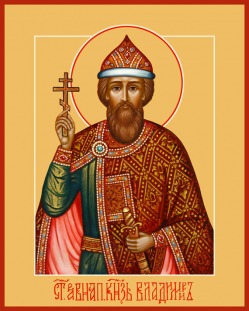
Prince Vladimir, the son of Svyatoslav and the pagan Malusha, was born in 963. In 972, he began to rule Novgorod, and in 980, after defeating his brother Yaropolk, he took over Kiev. He expanded the borders of his state, conquered Galicia, and fought against the Pechenegs. After the death of the Varangians Theodor and John, he began to doubt the pagan faith.
The prince invited preachers from various countries, and the Orthodox Greek preacher made the strongest impression on him. On the advice of the boyars, Vladimir sent ten wise men to Constantinople, where they were struck by the magnificence of the Hagia Sophia and the solemnity of the service. Convinced of the truth of Orthodoxy, Vladimir decided to be baptized, but he did not want to submit Rus to the Greeks. He took Chersonesus and demanded the hand of the emperors' sister, the queen Anna, who could only become his wife if he accepted Christianity.
Soon after this, Vladimir was struck by blindness, but after being baptized in 988, he regained his sight and exclaimed: “Now I have known the true God!” Returning to Kiev, he baptized his twelve sons and many boyars, destroying idols, including Perun. The prince called the people to baptism, and all the inhabitants of Kiev, following his example, came to the banks of the Dnieper.
After Kiev, Christianity spread to Novgorod, where the first metropolitan Michael baptized the people in 990. In 992, the faith was established in the Suzdal region. Vladimir ruled in Rus for 28 years after his baptism and 33 years on the throne of Kiev, passing away on July 15, 1015, in the village of Berestove. His body was buried in the Desyatynna Church.
The children of Saint Vladimir continued to spread Christianity in their principalities. In the 10th century, the faith was established in the cities of Murom, Polotsk, Vladimir-Volynsky, Smolensk, Pskov, and others. The Christian faith spread peacefully, thanks to the preaching and efforts of Saints Cyril and Methodius.
The faith also penetrated among the non-Russians living near Rus. In western Russia, Orthodoxy faced resistance from the Roman Catholic Church, but in the 14th century, the martyrdom for the faith of three nobles of the Lithuanian prince Olgerd contributed to its spread.
