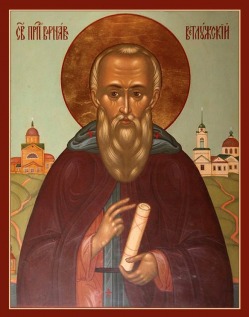
Saint Varvara of Vetluga was born in Veliky Ustyug and served as a priest in one of the city churches. In 1417, he settled on the banks of the Vetluga River on the Red Mountain, where he lived in solitude for 28 years, "working for God in psalmody and prayers." Divine beasts came to the saint, and he communicated with them as if they were domestic animals.
There were no human dwellings in the vicinity, and only occasionally people visited him, to whom he foretold that after his passing, monks would live in this place. In 1439, Saint Macarius came to him for guidance. Saint Varvara reposed on June 24, 1445. After his death, many monks and farmers came to his place of asceticism, and the people multiplied along the entire river.
On the Red Mountain, two churches were built: one in honor of the Holy Trinity, the other – over the saint's grave – in the name of Saint Nicholas the Wonderworker, and a communal monastery was founded, which received the name "Varavinsky Desert." The life of the saint was written in 1639 by the monk Joseph of the Varavinsky Desert.
The news of the saint's miracles reached Patriarch Joasaph, who learned of the miracles from the presbyters John and Onesiphorus. One of them was healed from blindness at the saint's grave. The Patriarch sent the igumen Pafnuty to the monastery to verify these miracles, and after gathering testimonies about the miracles, the memory of the saint was glorified.
Over time, on the site of the Varavinsky monastery, a district town named Varavino arose, and the main church of the monastery became the city cathedral in honor of the Apostle Barnabas.
