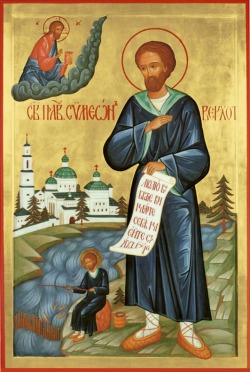
He was born in the early 17th century into a family of pious nobles. Leaving earthly wealth, he withdrew beyond the Ural Mountains, where he lived as a simple wanderer, concealing his origins. He visited the village of Merkušinskoe, where he prayed in a wooden church.
With the good news of the Triune God, he traveled through the surrounding villages, not shunning even non-believers, awakening in their hearts a desire for a virtuous life. In the taiga, he devoted himself to contemplation, seeing the wisdom of the Creator in every living being.
He did not remain idle; he knew how to sew fur coats and worked in the homes of peasants, refusing any reward. He left work unfinished to avoid praise and bore insults with humility, praying for his offenders.
He prayed much for the strengthening of faith among the newly enlightened inhabitants of Siberia, combining prayer with kneeling on a stone in the taiga. Having a secluded place on the banks of the Tura River, he caught fish, taking just enough for sustenance.
He passed away in 1642 and was buried at the Merkušin cemetery near the church of the Archangel Michael. In 1692, fifty years after his death, the villagers discovered the incorrupt body of the righteous man, which had been forgotten. Miracles of healing began to occur.
The Siberian Metropolitan Ignatius sent people to witness the facts. One of them, Hierodeacon Nikifor Amvrosiev, saw the righteous man appear, who introduced himself as Simeon of Merkušin.
The Metropolitan, having confirmed the incorruption of the relics, declared that they were similar to the relics of the ancient saints. Through the prayers of Saint Simeon, the Lord grants gracious help, comfort, and healing of souls and bodies.
On September 12, 1704, by the blessing of the Tobolsk Metropolitan Philotheus, the transfer of the holy relics of the righteous Simeon of Verkhoutory was performed to the monastery in honor of Saint Nicholas. The Church celebrates the second memory of the saint on December 18.
