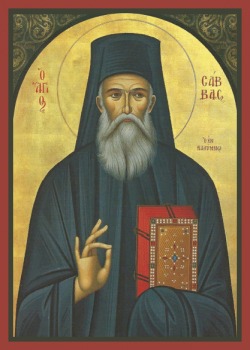
Saint Savva (born Vasily) was born in 1862 in the village of Iraklitsa in Eastern Thrace. His parents were poor and simple people. From early childhood, Vasily was distinguished by deep faith and love for the Church. He ran away from home and came to the cell of the Dormition of the Most Holy Theotokos on Mount Athos. After twelve years of ascetic life, he set out as a pilgrim to Jerusalem and received monastic tonsure in the monastery of Saint George the Chozebite in 1890. In 1894, the abbot of the Kalinnik monastery blessed him to return to the Holy Mountain of Athos to perfect his skills in iconography and to study Byzantine church music.
In 1897, he returned to Jerusalem, where he remained until 1916. During this period, the Saint asceticized on the banks of the Jordan. In 1903, he was ordained a priest and served at the Patriarchal School of the Venerable Cross. Then the saint withdrew again to the skete of the Hoziv Monastery, where he led a strict ascetic life, his only activities being prayer and icon painting.
In 1916, the saint returned to Greece. He spent two years on the island of Patmos, and then several months on Athos. Learning that he was being sought by Metropolitan Nectarios of Pentapolis, he went to the island of Aegina, where he remained for two years. His communion with Saint Nectarios and his guidance completed the spiritual development of Saint Savva.
After the death of Saint Nectarios, the Venerable Savva went into seclusion. After forty days, he came out of his cell with an icon of Saint Nectarios, asking the abbess to place it in the church. He spent several more years on the island of Aegina, collecting donations and teaching iconography.
In 1926, Saint Savva moved to the Monastery of All Saints on the island of Kalymnos, where he built a cell. He became a true father to all Kalymnians, enlightening the people and helping the poor. His food consisted of a few pieces of prosphora and a little wine. Saint Savva devoted no more than two hours a day to sleep, spending the rest of the time in the service of God.
During World War II, he prayed for the people, blessing enemy planes with the sign of the cross. The Venerable one was strict with himself and lenient towards others, unable to reconcile with blasphemy and condemnation.
Before his death, Saint Savva secluded himself for three days in his cell. Coming out of seclusion, he gave his last instructions about love for Christ and departed with the words: “Lord, Lord, Lord, Lord!” His soul ascended to heaven on a golden cloud to the sounds of heavenly singing on March 25, 1948.
In 1957, by the blessing of Metropolitan Isidor of Kalymnos, the grave of the Venerable Savva was opened, where a wonderful fragrance spread. Numerous miracles occurred, which did not cease.
The name of the Venerable Savva the New is included in the Menologion of the Russian Orthodox Church. The glorification of the Venerable was completed by the Orthodox Church of Constantinople in February 1992. The memory of the saint is celebrated on the fifth Sunday of Great Lent.
