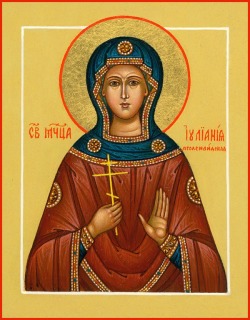
The commemoration of Saints Paul and Juliana was established in honour of their martyrdom and confession of faith before Emperor Aurelian.
In the third century, the emperor visited the city of Ptolemais in Phoenicia, where he was welcomed by the local inhabitants. Among the crowd was a Christian named Paul. When he saw the emperor, he made the sign of the Cross, and those around him noticed it. Paul was taken to prison, and the following day he was brought to trial. Before everyone present, the young man declared that he professed faith in Christ the Saviour. Having openly confessed his faith in Christ, he was subjected to cruel tortures.
Seeing her brother’s sufferings, Juliana accused the emperor of injustice and was likewise tortured. The brother and sister were brutally beaten, thrown onto red-hot grates, and their bodies were torn with sharp hooks. Nevertheless, Paul and Juliana endured their torments with patience. Among their torturers were the soldiers Quadratus, Acacius, and Stratonicus. Struck by the courage of the brother and sister, they declared themselves Christians and were immediately executed.
The emperor attempted to tempt Juliana, promising to take her as his wife if she renounced the Lord Jesus Christ. The maiden, however, remained faithful to the Saviour and indignantly refused. Enraged, the ruler ordered that the saint be violated, but everyone who touched her was immediately struck blind. Overcome with fury, Aurelian ordered the saints to be burned, provoking a storm of protest among the people. Unwilling to hear the murmuring of his subjects, the hardened emperor commanded that the martyrs be beheaded at once.
The brother and sister went joyfully to their execution, singing: “For Thou hast saved us, O Lord, from those who afflict us, and hast put to shame those who hate us” (Psalm 43:8).
