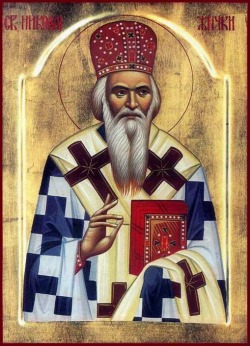
Bishop
Nikola Velimirović was born on December 23, 1880, in the mountain village of Lelić in western Serbia, into a large peasant family of Dragomir and Katarina Velimirović. It is known that his family moved to Lelić at the end of the 18th century from Osat in Bosnia.
He began his education at the school of the Ćelije Monastery, where his father sent him so that he would learn basic literacy, but only to the extent “that he could read notices from the authorities and reply to them,” and then remain in the village as a breadwinner and an “educated” man. From the very first days Nikola showed extraordinary zeal for learning. His giftedness was noticed by his teacher Mihailo Stuparеvić, who recommended that he continue his education at the Valjevo Gymnasium, where Nikola proved to be a good student.
After completing the sixth grade of the gymnasium, he attempted to enter the Military Academy, but the medical commission declared him unfit due to his short stature and insufficient chest volume. Immediately afterward, Nikola applied to the Belgrade Theological Seminary, where he was admitted, though again not without difficulty, allegedly because of a weak singing ear.
His studies at the seminary were successful. His achievements in learning were the result of systematic work. By the age of twenty-four, he had already studied the works of Njegoš, Shakespeare, Goethe, Voltaire, Hugo, Nietzsche, Marx, Pushkin, Tolstoy, Dostoevsky, and others. He was especially noted for his reflections on Njegoš, whom he loved as a poet and thinker since his years at the Valjevo Gymnasium.
During his studies in Belgrade, he contracted tuberculosis due to living in cramped quarters and poor nutrition. After graduating from the seminary, he worked for some time as a teacher in the villages of Dračić and Leskovice near Valjevo, where he became closely acquainted with the life and inner world of Serbian peasants and became friends with the priest Sava Popović, a refugee from Montenegro. Together they went among the people and assisted in parish matters. On the advice of his physician, Nikola spent summer holidays by the sea, where he came to know and lovingly described the life of the inhabitants of the Bay of Kotor, Montenegro, and Dalmatia. Already during his seminary years, he helped Aleksa Ilić edit the newspaper “Hrišćanski vesnik,” in which he published his first letters and works over several years.
He studied at the Old Catholic Faculty of Theology at the University of Bern, receiving in 1908 the degree of Doctor of Theology magna cum laude after defending a dissertation entitled “Faith in the Resurrection of Christ as the Foundation of the Dogmas of the Apostolic Church.” The work was written in German and published in Switzerland in 1910, and later translated into Serbian. He subsequently completed the Faculty of Philosophy at Oxford University, preparing a dissertation on “The Philosophy of Berkeley” for the degree of Doctor of Philosophy, which he defended in Geneva in French.
Upon returning to Serbia, he began teaching at the Belgrade Seminary and simultaneously published his articles in Serbian church journals. After recovering from tuberculosis, he was tonsured a monk at the Rakovica Monastery near Belgrade, receiving the monastic name Nikolai.
In 1910, he went to Russia to study at the Saint Petersburg Theological Academy. During his studies, he traveled extensively throughout Russia, visiting all the most famous holy places and coming to know the Russian people more closely.
He returned to Serbia, where he was caught by the outbreak of the First World War. During the war, Father Nikolai confessed and gave Communion to Serbian soldiers at the front lines, strengthening their spirit through preaching. He donated his entire salary throughout the war to the needs of the wounded.
In 1920, he was consecrated Bishop of the Ohrid Diocese. On June 21, 1934, he was appointed Bishop of Žiča.
On November 18, 1942, he was arrested by Hitler’s personal order “to destroy the Serbian intelligentsia, to behead the leadership of the Serbian Orthodox Church, with Patriarch Dožić, Metropolitan Zimonić, and Bishop of Žiča Nikolai Velimirović foremost among them.” He was placed under detention at the Vojlovica Monastery in Pančevo, where on March 13, 1943, Thaddeus of Vitovnica concelebrated the Divine Liturgy with him. While in the monastery, Bishop Nikolai edited and revised the Serbian translation of the New Testament made by Vuk Karadžić. On September 14, 1944, together with Serbian Patriarch Gavrilo, he was transferred to the Dachau concentration camp, where they were held in a special section for high-ranking officers and clergy (German: Ehrenbunker). No other European religious figures of such rank were imprisoned there. Bishop Nikolai and Patriarch Gavrilo remained in Dachau until the end of the war and were liberated on May 8, 1945, by the 36th American Division. After his release, the bishop traveled to England and from there to the United States.
He spent his final days at the Russian Monastery of Saint Tikhon in the state of Pennsylvania, where he reposed on March 18, 1956. From the monastery, his body was transferred to the cemetery of the Serbian Monastery of Saint Sava in Libertyville, Illinois.
