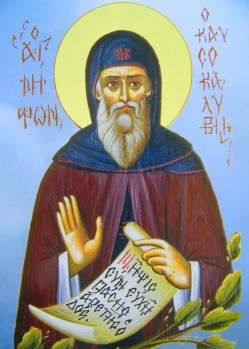
Saint Niphon Kausokalybites was the son of a priest from Gjirokastër. At the age of ten he entered the Monastery of Saint Nicholas, where he devoted himself to the ascetic life, until he was eventually ordained to the priesthood. Desiring to live in silence and devotion, he withdrew first into the wilderness and later to Mount Athos, where he became an ascetic under the Elder Theognostos. After three years of obedience, Niphon spent fourteen years in silence at the Skete of Saint Basil. He was later summoned to the Great Lavra to serve as a priest. Nevertheless, deeply longing for a hesychastic life, he went to the region of Vouleuteria and requested permission to leave the cenobitic community. He returned to the wilderness, where he survived by eating roots and wild herbs.
Despite his prayerful and spiritual way of life, he was accused of showing contempt for bread and ordinary food. The abbot therefore called him in repentance. The saint explained that he was striving to follow the example of the ancient Fathers, who sustained themselves on herbs from the earth due to the lack of bread. He nevertheless demonstrated humility and accepted the abbot’s guidance with obedience. Later, he drew near to Saint Maximos the Kausokalybite, who granted him his hermitage.
Saint Niphon was endowed with the gift of foresight.
Among other things, he foretold the death of Saint Maximos. Moreover, when plague struck the monastery, the saint prophesied the miraculous healing of his nephew Gabriel. On the eve of his death, he comforted his disciples, telling them that in the life after death he would pray for their salvation.
He fell asleep in peace on 14 June 1330, having lived for ninety-six years.
Saint Niphon was a remarkable and grace-filled figure of the Church. His virtue and radiant spirit strengthened the faith and obedience of his fellow monks.
