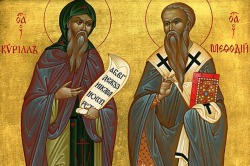
During the time of the iconoclast emperors, there lived in the city of Thessaloniki a nobleman named Leo, together with his wife Maria and their seven sons. The eldest was Methodius, and the youngest was Constantine, who later took the monastic name Cyril. Saint Methodius left worldly life and entered a monastery on Mount Olympus, where he devoted himself to the study of the sacred texts.
From a young age, Constantine showed deep piety, noble character, and great virtue. He was distinguished for his intelligence and remarkable memory, studied various sciences, and held a profound love for Saint Gregory the Theologian. After the death of Emperor Theophilus, Constantine was invited to study alongside the young Emperor Michael, where he demonstrated his brilliance and became known as “the Philosopher.”
Having been ordained a priest and appointed librarian, Constantine soon withdrew to a monastery. He also became a teacher of philosophy. He openly condemned heresies and defended Orthodoxy, taking part in the theological disputes concerning the veneration of the holy icons. At the age of twenty-four, he was sent to the Saracens, where he skillfully defended the Christian faith.
After returning to Constantinople, he again withdrew into solitude, entrusting himself to God’s providence. Later, by order of Emperor Michael, he set out with his brother Methodius to preach among foreign nations. Together, they enlightened many people with the teachings of the Christian faith, mastered numerous languages, and translated sacred texts, bringing countless souls to Christ.
