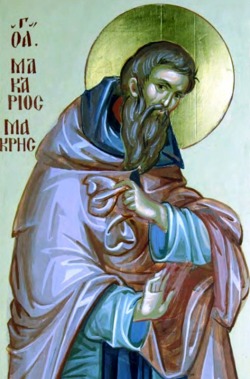
He was born around 1383 in Thessalonica into a noble and pious family. He received an excellent education and developed a love for science, especially philosophy and theology. Around 1401, after the death of his mother, he withdrew to the Holy Mountain and settled in the Vatopedi Monastery, becoming a novice under the elder Armenopoulos, who tonsured him a monk in 1409. During his years of obedience, Makarios acquired numerous knowledge and became a spiritual ascetic.
After the death of Armenopoulos, he became a novice under the ascetic David, with whom he maintained a friendly relationship, including correspondence with Emperor Manuel II Palaiologos. He visited his homeland only once to settle inheritance matters, after which he continued his ascetic life, inspired by the examples of the saints.
He was a fervent follower of hesychasm and was granted the vision of the Divine Light. Around 1419, he went to Constantinople at the invitation of the emperor, where he spent two years discussing theological topics. In 1429, after the death of David, he was invited back to the capital, where he initially lived in the Charsianit Monastery and later became the abbot of the Pantokrator Monastery, restoring its glory and spiritual state.
Makarios actively participated in church affairs, playing an important role at the Local Council of 1426-1429. In 1430, he led a delegation to Pope Martin V in Rome, defending Orthodox dogmas. However, he fell ill and could not continue his missions. He returned to Constantinople, barely recovering from his illness.
He passed away on January 7, 1431, in the Pantokrator Monastery. His death caused deep sorrow among the people and the clergy. Makarios is considered a significant writer of the 15th century, leaving a rich legacy of hagiographical and dogmatic works, defending Orthodoxy and calling for a true ascetic life.
