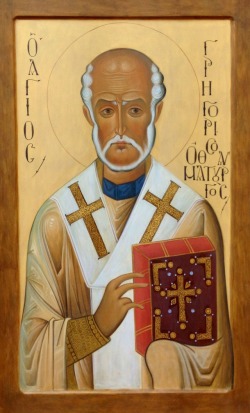
Bishop
Saint Gregory was born in the city of Neocaesarea into a pagan family. He received an excellent education. Having gone to Alexandria for a deeper study of the sciences, Gregory met there the famous teacher, the presbyter Origen, and was his disciple for eight years. From Origen, Gregory received Holy Baptism.
Returning to Neocaesarea, the saint chose to abandon worldly pursuits. He withdrew into the wilderness. Leading a strict ascetic life, the hierarch attained great spiritual perfection and the grace-filled gifts of clairvoyance and prophecy.
He wished to remain in solitude until the end of his life; however, Phaedimus, bishop of the Cappadocian city of Amasea, insisted that Gregory become bishop of Neocaesarea.
Before his consecration, Saint Gregory prayed fervently, asking God and the Mother of God to reveal to him the true manner of worshipping the Holy Trinity. During his prayer, the Most Holy Theotokos appeared to him together with the Apostle John the Theologian, who taught the saint how one should worthily confess the mystery of the Most Holy Trinity. Saint Gregory wrote down everything that the apostle revealed to him. This Revelation became the basis of the teaching on the Holy Trinity, which was later developed by the Fathers of the Church — Basil the Great, Gregory the Theologian, and Gregory of Nyssa.
Having become a bishop, Saint Gregory set out for Neocaesarea. On the way, he cast demons out of a pagan temple, and its priest turned to Christ. The convert then witnessed another miracle performed by the saint: at his word, a huge stone block moved from its place.
Saint Gregory zealously cared for the spiritual enlightenment of his flock. He preached often and fervently, healed the sick, helped those in need, and resolved disputes and grievances.
By the power of prayer, the saint once prevented a river from overflowing, marking with his staff the boundaries of the floodwaters. On another occasion, during the construction of a church, he commanded a mountain, in the Name of the Lord, to move aside and make room for the foundation.
During the persecution of Christians under Emperor Decius (249–251), Saint Gregory led his flock to a remote mountain. A pagan who knew the place where the Christians were staying revealed it to the persecutors. Soldiers surrounded the mountain. Then Saint Gregory came out into an open place, raised his hands to heaven and, instructing his deacon to do the same, began to pray. The soldiers searched the whole mountain, but, seeing no one, returned. They told the persecutors that on that mountain there stood only two trees, not far from one another. The informer was shaken by this miracle. He repented and became a Christian.
When the persecution ended, Saint Gregory returned to Neocaesarea. At that time, the false teaching of the heretic Paul of Samosata began to spread; he confused the Essence of the Indivisible Trinity with the Essence of the One God the Father. In 264, Saint Gregory presided over the First Council of Antioch, at which this heresy was condemned.
Through the ascetic labor of his whole life, Saint Gregory steadily increased the number of those who believed in Christ. He reposed in the Lord around 266–270. By that time, only 17 pagans remained in Neocaesarea. And when Saint Gregory had been ordained bishop, there had been only 17 Christians in the city.
