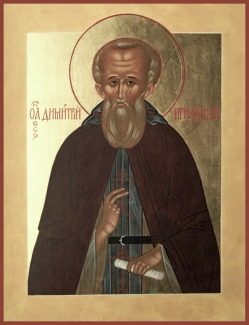
Venerable Demetrius was born at the beginning of the 14th century in Pereslavl-Zalessky, where his father, a wealthy man, carried on extensive trade. His parents believed in God and strove to strengthen the Christian foundation in their son. The seed of the Word of God bore fruit in the child’s pure soul. Unlike his peers, Demetrius was intelligent and humble, and he kept away from noisy children’s games and various amusements. Obedient to an inner calling and to the word of the Gospel, the young Demetrius left his father’s house and received monastic tonsure in the Goritsky Monastery of Pereslavl.
His humility, patience, and guilelessness were so great that they aroused the involuntary admiration of the brethren. For his ascetic labors he was deemed worthy of the priesthood. After some time, Demetrius decided to found his own monastery with a strict cenobitic rule. He moved to a marshy place, where he built a church in the name of Saint Nicholas and established a monastery beside it. The venerable one was very handsome, and therefore, to avoid temptation, he covered his face with his monastic klobuk and spoke with women very rarely, only when necessary.
During his abbacy in the Saint Nicholas Monastery, Venerable Demetrius formed a friendship in Christ with the father of northern Russian monasticism, Venerable Sergius, who was carrying out his ascetic struggle in the dense forests of Radonezh, sixty versts from Pereslavl.
The fame of his ascetic life was dangerous for Demetrius. He decided to leave his native region, taking with him only one disciple, Pachomius, and set out for the remote forested north. The venerable one and his disciple built a small church in honor of the Resurrection of Christ. But, meeting with opposition from the inhabitants, they left that place and went to Vologda. There they decided to found a monastery. All the inhabitants hastened to receive the saint’s blessing, and on August 1, 1371, a church was built and consecrated in the name of our Savior Jesus Christ, His Most Pure Mother, and in honor of the Life-Giving Cross of the Lord. Around the church, cells for the brethren and the most necessary service buildings were erected: thus arose the Spaso-Prilutsky Monastery, which became the first monastery with a strict cenobitic rule.
The monastery was not wealthy and was poor even in books. Demetrius led a truly ascetic way of life. His fasting was severe; for whole weeks he took no food. Only on feast days did he allow himself to partake of warm water and a small prosphora. As clothing he had only one old sheepskin coat, which he wore both in winter and in summer; in addition, on his body he wore heavy iron chains. At the end of his life, the venerable one was granted by the Lord the gift of clairvoyance.
On the night of February 11, 1392, the monks of the Spaso-Prilutsky Monastery noticed that a certain fragrance had spread throughout the entire monastery. All the brethren hastened to the elder’s cell, but found him already dead. His cell was filled with fragrance, and his face shone with an unearthly light; it was peaceful and quiet, like that of one asleep. Before his death, Demetrius had foretold his repose to the brethren. By the will of God, his coffin became a source of many grace-filled miracles and healings. Those who touched the coffin with strong faith were healed, and healings from demonic possession were especially frequent. A church was built in honor of Venerable Demetrius. The relics of the venerable one rest hidden beneath a covering in an arch within the lower church dedicated to his name. Above them stands a wooden shrine, covered with gilded copper sheets; upon the shrine lies a full-length icon of the venerable one in a silver riza, and opposite the shrine, at the ascetic’s feet, his chains hang under glass. The celebration of Venerable Demetrius in the Spaso-Prilutsky Monastery was established in 1409, when miracles began to occur at his coffin.
