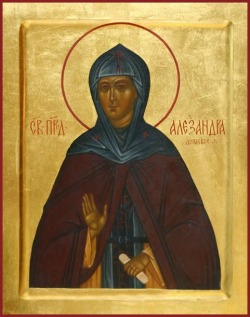
In the world, she was called Agafiya Semyonovna, coming from the ancient Ryazan noble family of Stepanovs. She was born into a pious family in the late 1720s – early 1730s. Losing her father early, she was raised by her mother in the spirit of piety. After the death of her husband, left with a small daughter, she chose the path of serving God.
Following the example of her husband's aunt, she accepted monasticism in the Kiev-Florov Monastery. Once, she was graced with a vision of the Most Holy Theotokos, who indicated to her a place for life in northern Russia, where a monastery would be founded. In 1760, following the indication, she stopped for rest in the village of Diveevo, where she saw the Theotokos again, who confirmed that this place was destined for her service.
Soon after this, in Diveevo, Mother Alexandra lost her only daughter, which became another sign of God's guidance for her. She decided to renounce her possessions and dedicate herself to service. In 1766–1767, she sold her Ryazan estates and returned to Diveevo, where she built a cell and lived for 20 years, forgetting about her origin.
She engaged in the improvement of the local church, built several chapels, and, by the indication of the Theotokos, began the construction of a stone church in honor of the Kazan Icon. The temple was consecrated in early 1780. Mother Alexandra also donated funds for the construction of the Assumption Cathedral in the Sarov Desert.
Leading a life full of labor and prayer, she governed the sisters in the spirit of meekness. In 1788, sensing her end, she accepted the schema with the name Alexandra. She died on June 13 at the age of no more than 60 years. Father Seraphim testified to her holy life and predicted that her relics would be revealed in the future.
After the closure of the Diveevo Monastery in 1927, her cell and grave were destroyed. In 1991, the grave was restored, and the holy relics were found in 2000 and transferred to the Church of the Nativity of the Theotokos. In 2000, she was glorified in the rank of locally revered saints, and in 2004 – in the rank of universally revered saints.
