Approximately 9 kilometers south of Jerusalem, on a hill covered with lush vineyards, fig trees, and olive groves, lies the city of Bethlehem. It is an exceptionally fertile land, as reflected in its name, which means “House of Bread” or “House of Meat” (Hebrew: Bet Lehem).
Today, livestock farming flourishes there, as the region offers ideal conditions for raising large flocks of sheep and other animals.
The city of Bethlehem was well known to the Jews. It was the place where Abraham stopped while he was travelling to Mesopotamia. It was also the birthplace of Obed, Jesse, and King David of Israel, all of whom are mentioned in the Old Testament.
However, the most significant event to take place in the city was the birth of Messiah, which occurred in a sacred cave carved into a natural rock.
The cave that welcomed the Divine Infant was known to the first Christians, who visited it with reverence and devotion. Later, around 100 AD, the Roman Emperor Hadrian invaded Palestine and desecrated the site that had served as Christ’s first dwelling place.
In 327 AD, during the reign of Constantine the Great, his mother Saint Helena built a magnificent church in that same spot. Designed in the shape of a cross, it remains one of the most important surviving monuments of Byzantine architecture.
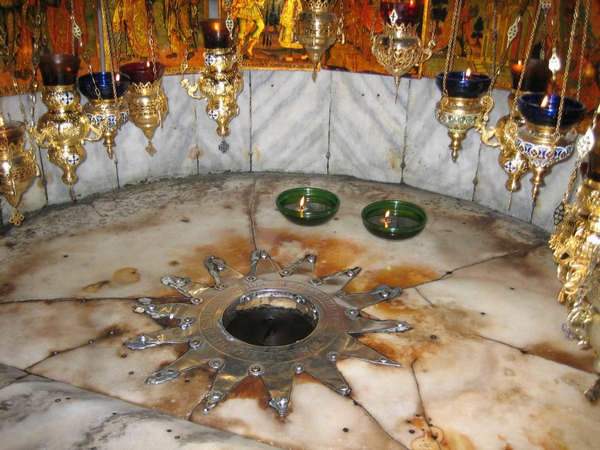
Directly beneath the church there lies the sacred cave, measuring approximately 12 by 4 meters with a height of 3 meters. Visitors must descend 13 steps to reach it. Candles provide the only source of light, casting a solemn glow across its walls.
The exact spot of Christ’s birth is marked by a large star made of silver and marble, embedded in the floor of the cave. Nearby there stands the manger that received the Divine Infant on earth.
Every year on December 25, the Nativity of Christ is celebrated in the cave with great splendor, attended by the Ecumenical Patriarch, officials, and countless faithful pilgrims.
According to tradition, when the Persian conquerors arrived there in 614 AD, they stood before the Church of the Nativity with reverence. Not only did they refrain from destroying it, but they also paid tribute to the Three Magi, who were Persians and were depicted in a mosaic on the western wall of the narthex.
In 1757, by decree of Sultan Osman III, the Greek Orthodox Patriarchate of Jerusalem regained full jurisdiction over the church and the cave.
The silver fourteen-pointed star, symbolizing the radiant Star of Bethlehem, marks the place where the Incarnation of the Word of God was fulfilled.
Saint Helena was also the one who discovered the original clay manger, which was later transferred to the Basilica of Santa Maria Maggiore in Rome. It remained there until the 12th century, while a silver manger took its place in the cave.
Right beside it, there is the place where the Magi worshipped the Lord. To the northwest of the cave there is, among other sacred sites, the well from which the Virgin Mary drew water to wash the newborn Jesus.