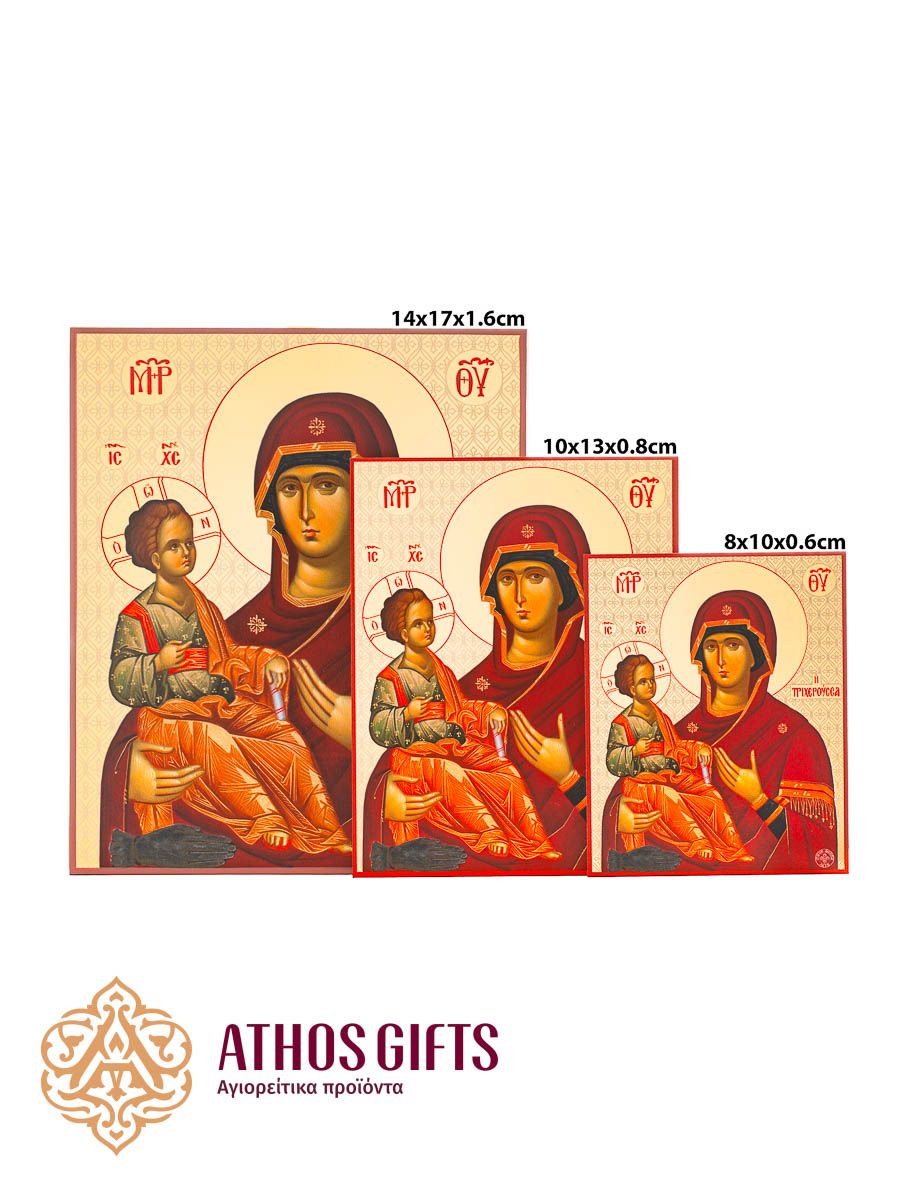
The miraculous icon of Theotokos Tricherousa (the one with the three hands) once belonged to Saint John of Damascus. It was brought to Mount Athos in the 13th century. Today, it is preserved as a sacred relic and regarded as the protector of the Monastery of Hilandar.
The icon originally belonged to the family of Saint John of Damascus and was first placed in the chapel of his home.
Between the years 705 and 715, the saint served as the chief adviser to the caliph of Syria. In this role, he had to deal with some of the most important matters of the state, including issues concerning the Christian population.
.jpg)
During that same period, the Byzantine Empire was shaken by the controversy of Iconoclasm. Saint John became one of the greatest defenders of the holy icons. For this reason, he was accused of heresy and persecuted as an idolater. The emperor Leo III the Isaurian, who sought to destroy him, wrote to the caliph and accused him of betrayal.
The caliph ordered his immediate arrest. Saint John was dragged to the central square of the city, where one of his hands was cut off, while he was mocked and humiliated. That same night, he prayed secretly before the icon of the Mother of God, asking for healing and strength so that he could continue his struggle. At some point he fell asleep. In a vision he saw the Virgin Mary telling him that the wound of his hand would be healed through her icon.
Saint John awoke and saw that his hand had indeed been healed. In his joy and gratitude, he commissioned a silver replica of it and placed it on the lower left part of the icon. This event became the reason why the icon came to be known as Theotokos Tricherousa, meaning the one with the three hands. After this miracle, Saint John of Damascus decided to abandon his position and embrace the monastic life. He traveled to Palestine and became a monk at the Holy Lavra of Saint Sabbas, taking the icon with him.
In the year 1217, Saint Sava, the son of Saint Symeon the Athonite (Stephen I Nemanja), brought the icon to Mount Athos and placed it in the Monastery of Hilandar. There it remained until 1347. Later, it was taken to Serbia by Stefan Dušan, who carried it with him as a blessing and placed it at the Studenica Monastery.
At the beginning of the 15th century, when the Serbs realized that their land was threatened by the Ottoman rule, they sought to protect the miraculous relic. The monks placed it on the back of a donkey and set the animal free, trusting that it would be guided by God’s Divine Providence.
The humble animal traveled across Serbia and Macedonia until it reached Mount Athos. The monks of the Monastery of Hilandar received the sacred icon of the Mother of God with great honor. According to tradition, the blessed donkey collapsed and died immediately after the icon was placed in the church.
Today, the icon of Panagia Tricherousa is regarded as the protector of the Monastery of Hilandar and of all the Orthodox Serbian people. It is an ancient Byzantine artwork, well preserved and of great value. According to some scholars, it was painted by some Greek iconographer during the 4th century. However, the monks of Mount Athos claim that it was created by Luke the Evangelist, who, according to tradition, painted icons while he was in Damascus, in the same time as Saint John.
The icon follows the iconographic type of Theotokos Hodegetria. The Mother of God holds the Holy Infant with her right hand, while her left hand is raised in a gesture of supplication.
.jpg)
The icon is painted on a large wooden panel measuring approximately 110 × 90 cm. It was originally intended for use in holy litanies. On the reverse side, there is a depiction of Saint Nicholas. Its covering is made of a precious metal surface adorned with gemstones, leaving visible only the faces and hands of the two figures. In earlier times, numerous coins and other offerings of gold and silver were hung before the icon by those who sought the intercession of Virgin Mary.
The Apolytikion
During the feast of the Synaxis of Theotokos in Mount Athos, there are chanted the following Apolytikion and Kontakion.
Apolytikion
From the Palestine, godly-minded Sabbas brought unto us thy venerable icon, which is known as Tricherousa (Of the Three Hands), Oh all-holy Bride of God. Wherefore, since the monks of Hilandar now possess it as their boast, they send up hymns of praise and thanksgiving, while crying out with fervour: Rejoice, thou who art full of grace.
Kontakion
Come, let us worship the famed icon of the Queen of all called: Tricherousa, for the fearful marvel which it wrought; and with fervent faith and longing, come, let us cry out: Oh pure Maiden, keep thy monastery and thy flock from all dangers, tribulations, and adversities, for we cry to thee: Rejoice, thou help and defence of all.