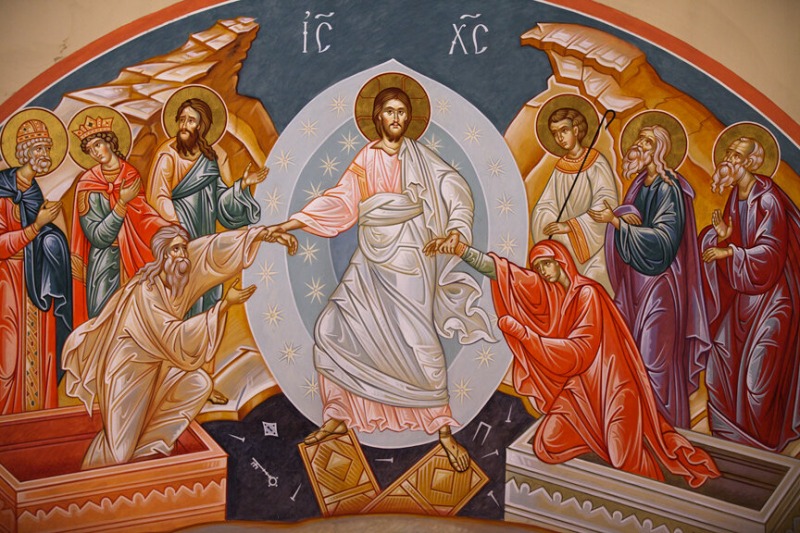
After the burial of Christ and mourning, the Lord descends to Hades, where he preaches the resurrection to the dead. Upon his Resurrection, Hades is abolished as it cannot bear His greatness. Jesus becomes the firstborn of the dead as well as the symbol of the resurrection of all human.
Gospel passage
According to the Gospel, the myrrh-bearing women went to the tomb of Jesus. By the time they arrived, there was a great earthquake, when an angel of the Lord came down and moved the stone that sealed the tomb. The body of Jesus was no longer there. The angel sat on the rock and addressed the myrrh-bearing women, explaining that they were vainly seeking for the living Jesus among the dead. He then urged them to quickly find the disciples of Jesus, in order to deliver them the message of resurrection and to inform that they should go to Galilee and meet the risen Christ. The myrrh-bearers left the tomb, trembling with fear and awe. On the way, Jesus appeared before them. The women fell at his feet, amazed at the sight of the risen Savior.
Meanwhile, the guards of the tomb froze in horror before the angel who moved the rock. According to the Gospel,
“And for fear of him the keepers did shake, and became as dead men.”
When they recovered from the shock, they ran into the city to report the event to the chief priests. They remained unrepentant and insisted on covering their mistake at all costs. They paid the guards and ordered them to spread the lie that Jesus's body had been stolen by his disciples during the night, when the guards fell asleep. And so, it was done. In fact, as the gospel passage claims,
“and this saying is commonly reported among the Jews until this day.”
In the last part of the Gospel, there's the revelation of Jesus to the Apostles. They go up to the mountain that had been indicated to them. When he appears before them, they fall down and worship him, while some of them hesitate in shock. Jesus approaches them and explains:
“All power is given unto me in heaven and in earth.”
He asked them to travel spreading his word to all nations and baptize people in the name of the Father, and of the Son, and of the Holy Spirit.
The presence of women in the event of the Resurrection
The female figures of the myrrh-bearers are the first witnesses to the event of the Resurrection. Jesus chooses to appear to them first, giving them the grace and privilege of being the harbingers of his rise from the dead. In fact, he appears to them even before his revelation to his disciples. According to theological interpretations, this choice is not accidental; it rather indicates the God’s will to restore, purify and elevate the female gender. For ages, women have been carrying down the stigma of Eve's sin and punishment. They have been maltreated and oppressed by strict impositions. Christ, on the other hand, intents to restore the position of women in society. Primarily, he restores it with the grace and beauty of the Blessed Virgin Mary, the Mother of God; and secondarily, by his compassion, forgiveness and honor expressed to women through different passages of the Gospel. His encounters with the bleeding woman and with the myrrh-bearing women are all examples of the restoration of the female gender in the history of Christianity.%20%D0%9B%D0%B0%D0%B2%D1%80%D0%B0%D1%91(1).jpg)
The message of the Harrowing of Hades
The Harrowing of Hades is a harbinger of the great event, the victory of Christ over death, the abolition of Hell and the exaltation of men to the eternal life. Starting from the morning, the church glorifies the resurrection of the Lord. Christ descends to Hades and proclaims the good news of salvation. In fact, as the icon of the Resurrection presents, he takes Adam by the wrist, dragging him out of Hell, even though he is unable to rise up on his feet and follow Him. The power of the Lord, as well as His will and capability to save men and draw them out of their suffering are thus pointed out.
Holy Saturday’s customs
During the morning of Holy Saturday, the church is decorated in red colors. All mourning covers have been already removed on the evening of Holy Friday. The church is decorated with laurel branches symbolizing victory. Celebratory hymns have already begun; the bell signifies the joyful event, the abolition of Hades, the breaking of the boundaries between life and death and the return of Christ to his Kingdom.