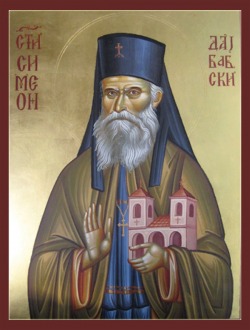
He was born in Cetinje in 1854, on the feast of Saint Nicholas, to the family of Vasa and Stana Popovich. At baptism, he received the name Savva. He lost his parents early but received proper upbringing in faith from his grandfather Milan and his brother Laza, a parish priest. He studied at the monastery school, where he particularly excelled in the knowledge of Church Slavonic and visual arts.
As a young man, he was torn between his grandfather's desire for him to marry and his aspiration to continue studying spiritual science. His father's brother, Michael, convinced his grandfather to send Savva to Kiev for further education. By the blessing of the Metropolitan of Montenegro, Hilarion, he became a student at the Kiev Seminary and Spiritual Academy. His spiritual father was Hieroschemamonk Nicholas, who led him to monasticism.
After completing his studies and being tonsured into monasticism, Savva continued his education in secular philosophy in Paris and Geneva. Soon, he was ordained as a deacon and then as a hieromonk. Upon returning to Montenegro, he served at the monastery of Saint Nicholas and was later transferred to the Ostrog Monastery, where he became a teacher at the first monastic school.
He served the Holy Liturgy, welcomed pilgrims, sharing stories about the life of the great Ostrog miracle worker. During this period, he made pilgrimages to the Holy Mountain Athos and the Holy Land. His life changed upon meeting the shepherd Petko Ivezich, who spoke of a vision of a saint calling for the construction of a monastery.
After building the church, he consecrated it in 1897. Saint Simeon became known as a prayerful intercessor, whose prayers healed the sick and helped the suffering. He wrote books with teachings on spiritual life and overcoming obstacles. His personality attracted the attention of both local and visiting pilgrims, who left records of his virtues.
Elder Simeon, sensing the approach of his end, predicted the coming trials and prayed to God to take him from life before they arrived. He died on April 1, 1941, and was buried in his little church. His burial place became a center of veneration, where healings and comfort for the suffering occurred.
