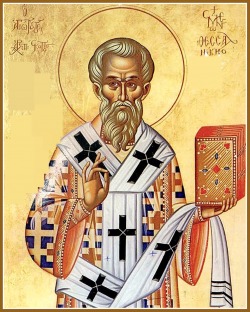
Archbishop
Saint Symeon of Thessalonica was born in Constantinople at the end of the fourteenth century. His secular name is unknown. Having received a theological education, he became a steadfast supporter of the theology of Gregory Palamas, a hesychast, a zealous follower of monastic ideals, and a defender of Orthodoxy. This conviction is reflected in his words: “The true good for people is to be Orthodox; and if they are not, it is better to die.”
In May 1416, he was consecrated Archbishop of Thessalonica and served in this office for the final thirteen years of his life. His health deteriorated at his new place of ministry, but, according to his own words, through prayer to the Great Martyr Demetrius of Thessalonica, he was able to regain his strength.
In June 1422, Saint Symeon visited Constantinople and, on his return journey, the Holy Mountain of Athos.
For almost the entire duration of his archpastoral ministry, Thessalonica remained under threat of either Turkish conquest or complete Venetian domination. Many inhabitants wished to surrender the city to the Turks in order to avoid the terrible fate of a city taken by force, while others wanted to entrust themselves entirely to the Catholic Venetians. The saint’s devotion both to his emperor and to Holy Orthodoxy earned him many enemies, yet he succeeded in keeping the city faithful to these ideals until his death in September 1429. Saint Symeon’s justice and his care for the poor won him universal respect even during his lifetime, so that even the non-Orthodox Venetians and the Jews mourned his death.
However, after his repose, the city was captured in 1430.
The saint left behind a great number of pastoral epistles on a wide variety of subjects. In his works, he appears as an interpreter of the divine services, a compiler of the Typikon, a composer of prayers, and a hymnographer.
