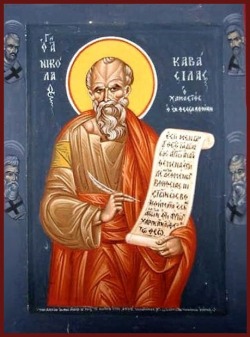
Nile and Nicholas Kavasilas, Thessalonian saints of the 14th century, were connected with the ecclesiastical and political life of the Byzantine Empire. Nicholas, born in 1320 in Thessalonica, received a classical education in Constantinople and actively participated in church affairs, holding the position of sakellarios of the Church of Constantinople.
In 1343, he was sent to Emperor John Cantacuzenus to persuade him to abdicate the throne. Later, in 1346, Nicholas participated in an embassy to Cantacuzenus' son, Manuel, promising obedience. He was a close friend of the emperor and followed him to the monastery when he withdrew in 1349.
Nicholas Kavasilas also took part in the election of a new Patriarch and was proposed for the patriarchal throne, which indicates his respect and significance. In 1351, at the Vlaherna Synod, he defended Orthodoxy and a strict ascetic life.
His literary legacy includes commentaries, moral words, and theological works, among which the most famous is the 'Explanation of the Divine Liturgy.' Saint Nicholas Kavasilas was canonized by the Greek Orthodox Church on June 3, 1982.
