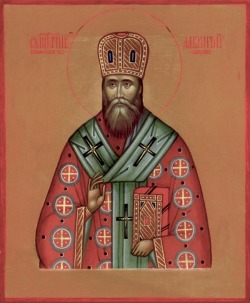
Bishop Lavrenty (in the world Evgeny Ivanovich Knyazev) was born in 1877 in the city of Kashira. He came from a clerical background and was the only son of a widowed mother. He received his primary education at the Veniev Spiritual School and his secondary education at the Tula Seminary. In 1902, he graduated from the Saint Petersburg Theological Academy with the degree of Candidate of Theology. On January 28, 1902, he was tonsured into monasticism by Archbishop Sergius (Stragorodsky) on Valaam, and on February 5, he was ordained a hieromonk.
On February 28, 1912, he was appointed rector of the Lithuanian Theological Seminary and the abbot of the Vilnius Holy Trinity Monastery. In 1917, Metropolitan Tikhon presented him for ordination, and in February 1917, Archimandrite Lavrenty was ordained as Bishop of Balakhna, vicar of the Nizhny Novgorod Diocese.
Bishop Lavrenty was a diligent practitioner of the Jesus Prayer, a disciple and spiritual friend of the Optina Elders. Once, the Optina Elder Anatoly Zertsalo, when asked by a woman whether her bishop was raising her correctly, replied that he was raising her perfectly and bowed to him three times. This was shortly before the martyr's death of the bishop.
In Nizhny Novgorod, Bishop Lavrenty blessed the establishment of the Spaso-Preobrazhenskoe Brotherhood for the revival of church and public life. Meetings were held on Wednesdays at the home of A. Bulgakov. Bishop Lavrenty was an unwavering participant in them.
In Nizhny Novgorod, the bishop lived and served in the Pechersky Monastery. He often served, loved to read akathists before the Athonite icon of the Quick to Hear. After each service, he preached and blessed all the people after the liturgy.
His last three sermons ended with the same words: “Beloved brothers and sisters, we are experiencing a very special time – we all face confession, and some even martyrdom.” At the Bulgakovs' house, he spoke of being foretold a martyr's death.
On April 3, 1918, Bishop Lavrenty wrote to Patriarch Tikhon about his difficulties in managing the diocese. At the end of August 1918, the Chekists arrested Bishop Lavrenty. In prison, he was offered to occupy a separate cell, but he preferred to remain in the common one.
In his free time, while in the cell, the bishop constantly prayed, ignoring the mockery of his fellow inmates. A great consolation for the bishop was the permission to serve in the prison chapel.
On October 24/November 6, Bishop Lavrenty and Father Alexius were told that they would be shot, and they were offered clemency if they renounced their ordination. It goes without saying that such a renunciation was unthinkable. The bishop had the Holy Gifts with him. He communed himself and communed Father Alexius.
Russian soldiers refused to shoot because they heard the singing of the Cherubic Hymn. Latvians were called in, and they carried out the sentence. That same night, the investigator came to E.I. Shmeling, brought the bishop's belongings, and said that the bishop had committed no crime.
A few days later, Elizaveta Shmeling, passing by the Cheka building, saw a cart leaving with two bodies lying on it.
