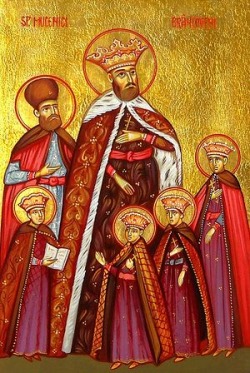
On the 28th of October 1688, Șerban Cantacuzino, Prince of Wallachia, reposed. During his reign, numerous monasteries were built and the translation and publication of the Holy Scriptures in Romanian began. On the same day, the Wallachian boyars placed his nephew, Constantin Brâncoveanu, on the throne. He was a highly educated man, he spoke Greek and Latin, while he also knew Church Slavonic.
His reign began in difficult times, as the Ottomans were at war with the Austrians. Endowed with remarkable diplomatic skills, the new prince managed to maintain friendly relations with all the opposing sides, thereby saving his country from the devastation of war. His 26-year reign marked a period of flourishing Orthodoxy, culture and the arts in Wallachia. New churches and monasteries were built, schools were established and books were published in various languages.
Constantin was one of the greatest patrons of monasteries and churches. In the summer of 1690, the foundations were laid for Hurezi Monastery, dedicated to Saints Constantine and Helen. Ramnicu-Sărat Monastery was also built, while numerous churches were renovated. Three new churches were erected in Bucharest, of which only the church of the Monastery of St George the New survives till today. The saint supported the Church and all the monastic communities throughout the Balkans and the Middle East, consistently offering assistance to all four Orthodox patriarchates.
With his deposition this period of flourishing came to an end. The intrigues of his opponents, together with the defection of one of the boyars to the Russian side, aroused the suspicions of the Ottoman authorities.
He was then summoned, together with his family, to Constantinople. When they arrived in March 1714, during the Holy Week, they were imprisoned in the fortress of Yedikule. They were promised that their lives would be spared if they agreed to convert to Islam. However, the prince firmly rejected their offer.
On 15 August 1714, the day of the Feast of the Dormition of Theotokos, when the prince had just turned sixty, he was led to the place of execution. In the presence of the Sultan, foreign ambassadors, his wife and daughters, who had been forced to witness this inhuman spectacle, the saint and his four sons were beheaded. The first to be executed was Ianache Văcărescu, the prince’s closest counsellor, followed by his sons Constantine, Stephen, Radu, and Matthew. Only after witnessing and enduring their martyrdom was the saint himself led to his death. Their heads were impaled on spears and paraded through Constantinople, while their bodies were thrown into the Bosphorus the following day. Christian fishermen recovered their holy remains from the sea and buried them in a Greek monastery on the island of Halki.
Through his martyrdom, Constantin Brâncoveanu became an example of sacrifice and steadfast confession of faith. On 20 June 1992, the Holy Synod of the Romanian Orthodox Church officially recognised him as a New Martyr and Confessor.
