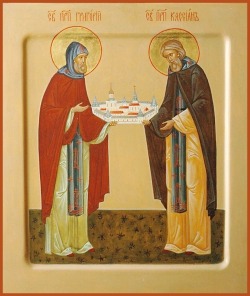
In the second half of the fourteenth century, the hermits Stephen, a disciple of Sergius of Radonezh, and Gregory settled in the Avnezh district, along the Sukhona River, on the Avnezh Upland. Around 1370, they built a church and cells for the monks. They were assisted by a wealthy peasant named Konstantin Dmitrievich, who later received monastic tonsure with the name Cassian and was appointed cellarer of the new monastery when Grand Prince Dmitry Ivanovich Donskoy summoned Stephen to Moscow.
At the end of the fourteenth century, the monastery suffered greatly from raids by the Kazan Tatars and men from Vyatka. During one such raid, in 1392, both ascetics—Cassian and Gregory—were killed. After their martyrdom, the monastery fell into complete desolation. The Avnezh Monastery remained deserted for 132 years, and the site on which it had stood became entirely overgrown with forest.
After the Tatar yoke had been overthrown, a peasant named Gabriel cleared the forest on the site of the former monastery. He noticed that one spot had not burned and, after digging there, found two coffins. The elder Gregory appeared to him and instructed him to build a church on that site.
A chapel was erected there, and in 1560, Varlaam, abbot of the Monastery of the Holy Trinity, built a monastery near the resting place of the saints at the tsar’s expense. In 1764, the monastery was converted into a parish church. With the blessing of Metropolitan Macarius, Bishop Joasaph of Vologda examined their relics, after which they were enshrined beneath the floor of the new monastery.
