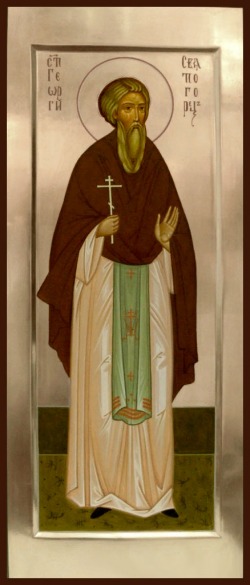
Saint George of Iveria, Athonite, was born in Trialeti (the region of Southern Georgia) in 1009 in the family of noble owners Maria and Jacob. At the age of 7, he was brought to the Tadzri Monastery, where he was miraculously saved from death twice.
In 1019, at the request of his uncle, he received a blessing to be raised by the strict ascetic Hilarion of Tualeli. In 1022, Saint George was sent to Constantinople, where he studied for twelve years.
Returning to Georgia in 1034, he took monastic vows at the Khakhuli Monastery. Having given his clothes to a beggar, he went on a pilgrimage to the holy places of Palestine. Later, he found a spiritual mentor in the Monastery of Saint Simeon the Stylite.
In 1040, the saint arrived at Mount Athos and continued the work of translating liturgical books, begun by Saint Euphemius of Iveria. His translations were recognized as exemplary by the Georgian Orthodox Church.
In 1042, he was ordained to the priesthood and appointed senior hieromonk. After the death of the abbot in 1044, Saint George was elected the new abbot of the Iverian Monastery.
He strengthened the cathedral and confirmed the rights of the Georgians to the Iverian Monastery by visiting Constantinople and receiving a charter from Emperor Constantine IX.
After this, he went to the Black Mountain, where he convinced the Patriarch of Antioch of the canonical legitimacy of the autocephaly of the Georgian Orthodox Church. In Georgia, the saint spent five years teaching the people and implementing his translation works.
In 1065, before his death, he hastened to present his students to Emperor Constantine X and received a charter for their education. Saint George peacefully departed to the Lord on June 29, 1065. His incorrupt body was transferred to Mount Athos and placed in a tomb.
With the consent of the Catholicos-Patriarch of all Georgia John IV, the memory of Saint George was celebrated annually on June 27, coinciding with the day of his blessed repose.
