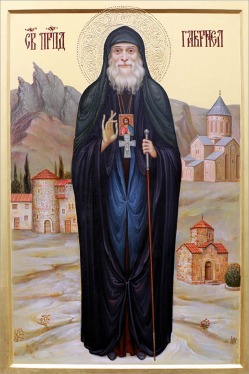
Archimandrite
Father Gabriel’s secular name was Goderdzi Urgebadze. He was born on 26 August 1929 in Tbilisi, into the family of a staunch communist. His father died when he was still very young.
One day, the boy overheard a loud argument between two women who lived nearby. One of them shouted at the other: “Do not crucify me as Christ was crucified on the Cross!” Astonished, the boy asked, “Why was Christ crucified?” No one could answer him, but they advised him to go to the local church, which was closed. The caretaker secretly opened the church, showed the boy the Crucifixion of Christ, and advised him to read the Gospel. He saved up enough money to buy a copy of the Gospel and, within a few years, knew almost the entire text by heart.
The desire to become a monk arose in him while he was still young. The elder would later say: “There is no greater heroism than monasticism.” For a long time, his mother opposed her son’s desire to embrace the monastic life. Toward the end of her life, however, she accepted his choice and later received the monastic tonsure herself. She was buried at Samtavro Monastery.
In 1949, the young man was conscripted into the Soviet Army. He served in a border-guard unit in Batumi. He entered a church and prayed for a long time before an icon of Saint Nicholas the Wonderworker, asking that he be given more opportunities to attend church. God’s mercy was not long in coming: he was appointed as a postman, which enabled him to visit the church after completing his duties. On Wednesdays and Fridays, he fasted, explaining his abstinence by claiming that he suffered from stomach pains. A priest secretly gave him Holy Communion in the altar. Thus, throughout his military service, he combined his duties in the army with the life of the Church.
After returning from the army, he was not spared further trials. In those godless times, Orthodox Christians were cruelly persecuted. The young man was summoned to a medical clinic and interrogated. Afterward, he was declared mentally ill and sent home under his mother’s supervision. He was granted a category-two disability pension.
He began building a church in the courtyard of his home and completed it around 1962. He found icons for the church at rubbish dumps and restored them in his workshop. The walls of his church were entirely covered with sacred images. He even framed photographs and reproductions of icons cut from secular magazines.
With the blessing of Patriarch Melchizedek III, Vasiko began working first as a caretaker and then as a psalm-reader at the Sioni Cathedral. On 25 January 1955, at the age of twenty-six, he submitted a petition to the Church authorities requesting appointment as an unpaid deacon of the cathedral. Soon afterward, he addressed a new petition to Bishop Gabriel of Kutaisi and Gaenati: “Since childhood, I have felt drawn to monasticism. Therefore, I humbly ask you to tonsure me into the small schema and give me the name of Saint Gabriel of Mount Athos.”
Deacon Goderdzi Urgebadze was tonsured a monk with the name Gabriel on 27 February 1955 at Motsameta Monastery by the Bishop of Kutaisi and Gaenati. Three days later, at the Cathedral of the Holy Apostles Peter and Paul, Bishop Gabriel Chachanidze ordained him a hieromonk.
On 1 May 1965, International Workers’ Day, an event occurred that shook the entire country: Father Gabriel poured kerosene over a twelve-metre portrait of Lenin mounted on the building of the Council of Ministers and set it on fire. For this, he was beaten by an enraged crowd, arrested for “anti-Soviet activity,” and taken to a KGB detention centre. The only reason Father Gabriel was not executed for this act was his psychiatric diagnosis. On 19 November 1965, he was discharged from hospital and sent home.
In the 1980s, he settled at Samtavro Monastery, where he lived in a round tower. His love for people and his ascetic labours inspired the admiration of the nuns.
One of the qualities that distinguished Father Gabriel was courage. He feared no one and nothing. He could rebuke presidents, ministers, heavily armed men, and ordinary criminals. Such power emanated from him that those who opposed him preferred to remain silent and withdraw. In time, we came to understand that this was a power before which all bow down, a power capable of taming not only a sinful human being but even the fiercest lion: the power of prayer and love.
Father Gabriel died of dropsy on 2 November 1995. His body was wrapped in a mat and committed to the earth.
On 24 December 2012, he was glorified among the saints as a venerable monk. On 22 February 2014, his incorrupt relics were uncovered.
On 25 December 2014, the Holy Synod of the Russian Orthodox Church resolved to include the name of Saint Gabriel in its liturgical calendar.
