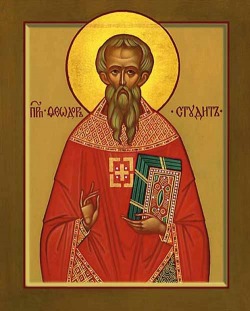
Born in 758 in Constantinople, he received a broad education and successfully opposed the heretics of iconoclasm. After taking monastic vows, he became the abbot of the Sakudion monastery, where he set an example of virtue. In 796, for defending the church's rules, he was exiled to Thessalonica.
Upon his return from exile during the reign of Empress Irene, he managed the deserted Studite monastery, where he gathered up to a thousand monks. He composed a communal rule for monastic life, known as the Studite Rule. He is credited with many soul-beneficial books, canons, and tripesnces.
Under the emperors Nikephoros I and Leo the Armenian, he suffered greatly for the veneration of icons, being exiled to Illyria and then to Anatolia. After the death of Leo the Armenian, he settled in Chersonesus.
Despite his illness, he celebrated the Divine Liturgy daily and taught the brethren. He died in 826. At that same hour, the blessed Hilarion of Dalmatia was revealed the blessed end of God’s servant.
In 845, his relics were transferred to the Studite monastery. His brother, the venerable Joseph, also suffered from the iconoclasts and died in 830 in the Studite monastery.
The venerable Theodore performed many miracles; those who called upon his name were delivered from fires and received healing from ailments.
