What does the Bible say about fasting?
Fasting is not a virtue in itself, but a means to acquiring virtue.
Through fasting, we learn to discipline and control our will, to humble ourselves, and to subordinate our bodily needs to our spirit. In this way, we express our love for Christ and our obedience to the rules handed down to us by the Holy Fathers of our Church. Thus, we draw near to the grace of the Lord, just as the saints and the prophets did.
Christ Himself was the first one to practice fasting for “forty days and forty nights”, while he was in the desert. He spoke about fasting only once. Yet He did not define the duration or the manner of the practice. As we read in the Gospel, He called upon the faithful not to complain or display their fasting publicly, for such behavior makes them hypocrites and unworthy of the Kingdom of Heaven. Instead, He urged people to fast quietly and with profound humility..jpg)
“When you fast, do not look somber as the hypocrites do, for they disfigure their faces to show others they are fasting. Truly I tell you, they have received their reward in full. But when you fast, put oil on your head and wash your face, so that it will not be obvious to others that you are fasting, but only to your Father, who is unseen; and your Father, who sees what is done in secret, will reward you.”
The specific days and duration of fasting periods, as well as the foods that may or may not be consumed, were later established by the Fathers of the Church.
Find all the necessary information about the feasts and fasts in the Athos.Guide calendar.
What is the actual meaning of fasting?
By the word “fasting” we often refer simply to abstaining from food. In reality, however, it is a much broader concept. To fast means to learn how to live under certain conditions, within specific limits that cultivate simplicity and humility, both in material and in the spiritual life.
Unfortunately, by misunderstanding the true meaning of fasting, more and more people refuse to fast, believing that rich and abundant food is what gives them strength. In doing so, they often fall into gluttony, so that instead of improving their health, they undermine it. Indeed, it is well known that in many parts of the world people suffer not from hunger or malnutrition, but from obesity, hypertension, and high cholesterol.
Christian fasting is a living and practical form of teaching. It is a free choice, a spiritual struggle that leads us toward union with the Divine Grace. It constitutes an act of repentance, humility, and obedience to Jesus Christ. Our refusal to accept the practice of fasting often reveals our pride and the fact that we surrendered ourselves to the passions of our flesh.
Fasting is not about analyzing the ingredients of our foods or being excessively concerned regarding them. What matters is not carefully examining what each food contains before consuming it, but struggling against the small or big desires of our body, calming the mind and the soul, setting aside the anxieties and demands produced by our human needs. These factors usually distract us, weaken our faith, conscience, and love, keeping us far from the life proposed by the Church.
Fasting is repentance. It is the effort to change our life and restore it to the path of God..jpg)
A Guide to Christian Fasting
The fasts of the ecclesiastical year are numerous and varied. It is therefore useful to consult the Church calendar regularly, where all the details regarding how to fast each day are clearly indicated.
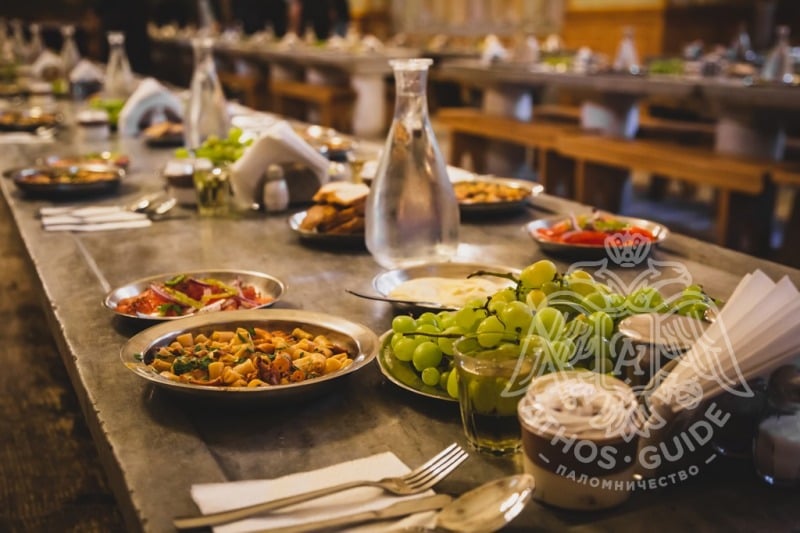
On our website, you can also find monastic recipes for dishes that are flavorful and suitable for all fasts.
Below there are the most significant fasting periods, with brief guidelines for each:
- Every Wednesday and Friday
On these days, one should abstain from meat, dairy, and eggs, as well as from oil and alcohol. Legumes, seafood (excluding fish), vegetables, fruits, bread, and similar foods are permitted. - The Eve of Theophany
On this day, the fasting rules mentioned above apply. - The Great Lent
In the early Christian centuries, oil was permitted only on Saturdays and Sundays of the Great Lent, while on weekdays only oil-free foods were consumed. This practice led to the “dry food” days, which are still observed by some Christians during the first week of the Lent, as well as during the Holy Week.
In general, according to the Church canon, the fasting rules for the Great Lent are as follows: from Clean Monday to Holy Saturday, a strict fast is observed, consisting of dry food and abstinence from alcohol. Wine and oil may be consumed only on Saturdays and Sundays, allowing the faithful to partake in these foods on those two days each week. - The Christmas Fast
The Nativity Fast begins on November 15 and ends on December 24. During this period, fish is still permitted. - The Dormition of Theotokos (Assumption of Mary)
The fast preceding this feast is one of the most important in the Orthodox Church. From August 1 to August 14, a strict fast is observed, while wine and oil are allowed only on Saturdays and Sundays. Fish is permitted on August 6, the Feast of the Transfiguration of the Savior, which falls within this fasting period. - The Apostles’ Fast
This fast begins on the first Monday after All Saints’ Sunday and continues until June 28. Fish is permitted, except on Wednesdays and Fridays, when strict fasting rules apply.
