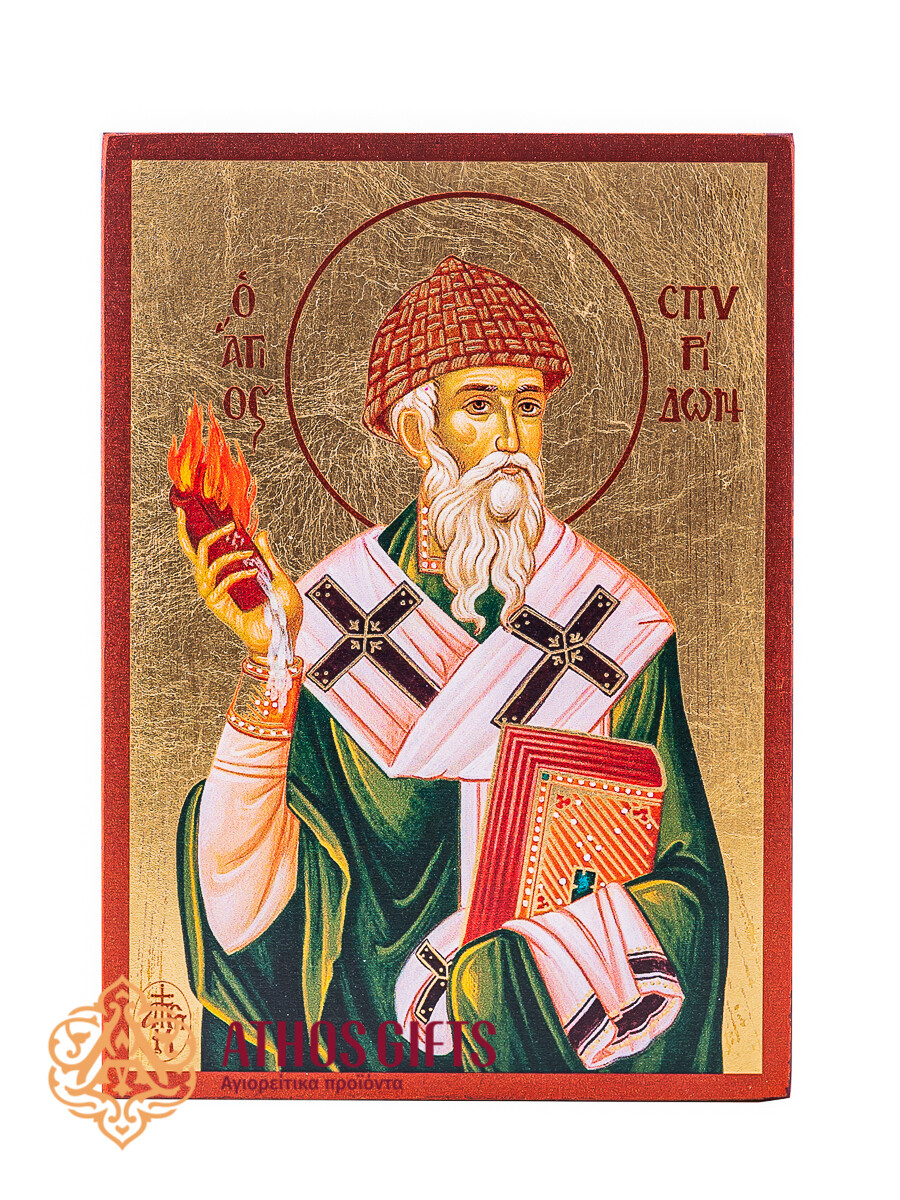
Saint Spyridon is one of the most important Holy Fathers of our Church. He preached the word of God during the early centuries of Christianity. Countless pilgrims from around the world venerate his grace, seeking enlightenment and salvation.
He was born in 270 AD. He lived during the reign of Constantine the Great (306–337) and his son Constantius II (337–361).
His birthplace was a small village on the island of Cyprus. His parents were farmers who lived in great poverty, yet they were virtuous and deeply religious. They raised their son with care and affection to God.
The Early Years of Saint Spyridon
Saint Spyridon was not a highly educated man, unlike many hierarchs of the Church. Nevertheless, the sacred texts—and especially the Bible—were his constant daily companion. Wherever he was, he studied the word of God and made great effort to follow it faithfully. He spent time reading either at home or while working, as he led his sheep out to graze.
There, in the open fields, he would sit under the shade of a tree or on a hilltop, holding the Bible. He felt delighted in the words of the Lord, while, like David, he sang hymns praising His greatness.
Often, he gathered around him other shepherds, teaching them the law of God with exemplary kindness and love. He strove to guide their souls toward the peace of Christian faith. Each day, his zeal, love, and humility further shaped his virtuous character.
Saint Spyridon became a model of courage and Christian endurance during times of persecutions. During the reign of Maximinus Daia (308–313), he was arrested and endured terrible sufferings. He was tortured harshly for his faith in Christ. His body was brutally wounded, yet nothing could shake his love for the Lord. Instead of pain and despair, he was filled with joy, recognizing his suffering as a gift leading to salvation.
The Family of Saint Spyridon
Saint Spyridon was released in 313 AD. Thereafter, he lived with his family, enjoying the warmth and companionship of his home. The flame of his faith in Christ remained unextinguished, while his love continued to serve as an example to others.
However, his wife passed away early, leaving the saint alone to raise their daughter, Irene.
The Virtue of Saint Spyridon
The saint was gentle and never complained. He often kept on his lips the words of the Book of Job:
“Naked I came from my mother’s womb, and naked I will depart. The Lord gave and the Lord has taken away; may the name of the Lord be praised.” (Job 1:21)
He prayed unceasingly, never losing hope. Even in the most difficult moments of his life, he kept his mind focused on glorifying God, with faith and humility.
After losing his wife, he found comfort in the words of the Lord. They brought him peace and guided him toward salvation.
Soon, his piety and virtue made him deeply beloved—not only among the people of his city but also in the surrounding regions. All those in need or suffering turned to him, finding refuge and spiritual strength. Orphans saw him as a father figure, while people sought his support and protection.
Saint Spyridon as a Shepherd of Souls
When the priest who served the church and the needs of the local community passed away, the people increasingly turned to Saint Spyridon, urging him to devote himself to the teaching and spiritual guidance of the flock.
After persistent appeals from the faithful, the saint was appointed the first bishop of Tremithus. He continued his virtuous work, becoming a living symbol of love and kindness.
It is said that the door of his home was always open to strangers and travelers, who admired and respected him for his compassion. Hospitality, for him, was a way of life. The saint expressed his love for others through specific actions: anyone who came to his house found a place to rest, eat, drink, and spend the night.
Indeed, the bishop himself, following the example of Christ, would often bring water and humbly wash the feet of the travelers, offering them care and comfort.
The Holy Councils and the Miracle of Saint Spyridon
According to historical sources, Saint Spyridon took part in the First Council of Nicaea, convened by Constantine the Great in 325 AD.
At that time, many church leaders were working to safeguard the true doctrine and establish the faith. Arius, along with the false teachings he spread, posed a serious threat to the Church and to Christianity.
Although Saint Spyridon lacked formal education, through the Divine Grace and the providence of God he became a fervent defender and witness of the truth of the Gospel. When the followers of Arianism relied on logic and philosophy to support their arguments, the saint—simple and humble—sought to demonstrate that God is Triune: that the Son is “of one essence” with the Father and “begotten” of Him “before all ages.”
In a miraculous way, he expressed this truth using a tile. Holding it in his hands and making the sign of the cross, he said:
- “In the name of the Father,” and flames sprang from it,
- “And of the Son,” and water began to flow,
- “And of the Holy Spirit,” and in his hand remained the clay from which the tile was made.
Thus, before the astonished eyes of all, he explained the mystery of the Holy Trinity, saying:
“Earth, water, and fire—three distinct elements—form a single brick. In the same way, the Holy Trinity consists of three Persons: the Father, the Son, and the Holy Spirit. These Persons coexist and are indivisible.”
In this way, the council—through the participation of Saint Spyridon—was able to refute false teachings and clearly articulate the doctrine of the divine nature.
The Feast and Holy Relics of Saint Spyridon

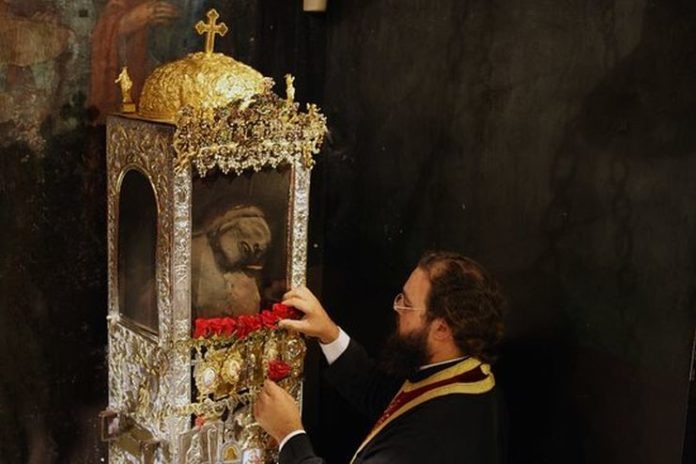
Saint Spyridon reposed in 348 AD, departing for the heavenly Kingdom. Yet he never abandoned his flock. His love and care remain close to the faithful, both through his spiritual presence and through his holy relics, which are said to remain incorrupt and fragrant to this day. The saint continues to protect and watch over those who turn to him.
During the Saracen invasions (648 AD), his relics were transferred from Cyprus to Constantinople by Justinian II.
Later, shortly before the fall of the city to the Ottomans, a priest named Gregory brought them to Corfu.
The Relics of Saint Spyridon in Corfu
Each year, thousands of faithful from around the world visit the Church of Saint Spyridon in Corfu, which was built in his honor with deep reverence. For many centuries, the saint has been the patron and protector of the region.
His miracles are countless. Prayers are offered to him from every corner of the world. Around his reliquary, numerous offerings and votive gifts have been placed by pilgrims in gratitude for the grace they have experienced.
All these bear witness to the deep devotion and reverence of the people. Saint Spyridon of Tremithus hears the prayers, intercedes, and begs the Lord on behalf of every believer.
Prayer to Saint Spyridon of Tremithus
O all-blessed and holy hierarch Spyridon, thou great favorite of Christ and most glorious wonderworker! Standing in heaven with the choirs of angels before the throne of God, look down with merciful gaze upon the people who stand here before thee and beseech thy mighty aid. Entreat the compassion of God Who loveth mankind, that He judge us not according to our iniquities, but that He deal with us according to His mercy. Ask for us of Christ our God a peaceful and undisturbed life, health of soul and body, bounty from the earth and abundance and prosperity in all things; and that we turn not the good things given us by our compassionate God to evil, but rather to His glory and the glorification of thine aid. Deliver all who approach God with unwavering faith from all retribution and from the assaults of the demons. Be thou a comforter for the grieving, a physician for the afflicted, a helper amid temptations, a shelter for the naked, an aid to the widowed, a defender of the orphaned, a nourisher of infants, a strengthener of the aged, a guide to travelers; and beg thou for all who are in need of thy mighty help all things which conduce to salvation, that, guided and protected by thy prayers, we may attain unto everlasting rest and with thee may glorify God Who is worshiped in the Holy Trinity: the Father, and the Son, and the Holy Spirit, now and ever, and unto the ages of ages. Amen