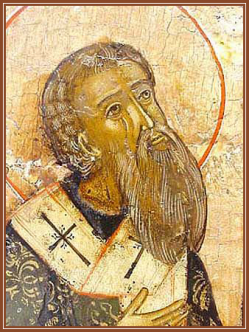
Bishop
Saint Zosimas, originally from Cilicia, devoted himself to God from an early age. Determined to leave the world behind, he set out for Mount Sinai, where he was tonsured a monk and began a life of ascetic struggle through fasting and prayer. Seeking an even more peaceful and contemplative life, he departed for the desert of Libya and settled in a remote place. There he met an elder who foretold that Zosimas would one day ascend the episcopal throne of the Church of Babylon in Egypt. After the elder’s death, Zosimas buried him and returned to Sinai.
Some time later a repentant thief came to him, whom the saint introduced to monastic life. For the man’s safety, however, he soon sent him to another monastery. After nine years the former thief returned, troubled by the sins of his past and unable to find inner peace. He wished to abandon the monastic life and return to the world. Thus he left the desert, confessed his crimes openly, got arrested, and endured a martyr’s death.
Saint Zosimas later travelled to the desert of Porphyrius with his disciple John. John died after a snake bite, but the saint encountered two hermits who brought him back to life. They instructed Zosimas to return to Sinai, where he would take up the episcopal throne.
Indeed, Saint Zosimas was consecrated bishop of the Church of Babylon. He took care of his people with faith and devotion, guiding many to the path of salvation. In his old age he left the episcopal throne and went back to Sinai, where he completed his earthly life.
On the feast day of Saint Zosimas, the Church also commemorates Saint Asteios, the Hieromartyr and bishop of Dyrrhachium, who was crucified during the reign of Trajan in the early 2nd century.
We also honor on this day the repose of Saint Methodius, who fell asleep in the Lord in 1392.
