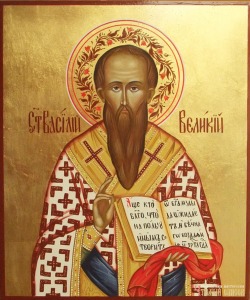
Archbishop
Saint Basil the Great was born in Caesarea of Cappadocia in 330 AD. He was raised in a large family, having eight siblings—three brothers and five sisters. Under the guidance of his father, he received an excellent education and was introduced to the principles of Christian faith. He studied under the finest teachers of the region and later continued his education in Constantinople and Athens.
There, he met Saint Gregory the Theologian, with whom he formed a close and enduring friendship. Around 357 AD, he returned to Caesarea, got baptized, and became a reader in the Church. He then traveled to Egypt, Syria, and Palestine before settling on the banks of the River Iris in Asia Minor. There, he gathered many monks around him, forming a monastic brotherhood. Together, they practiced strict asceticism, lived devoutly, and studied the Holy Scriptures.
During the reign of Emperor Constantius, one of the greatest challenges faced by the Church was the Arian heresy. Saint Basil and Saint Gregory were called upon to defend the Orthodox faith. In 362 AD, Basil was ordained a deacon; in 364 AD, he was ordained a presbyter; and in 370 AD, he became Bishop of Caesarea.
He supported the faithful during difficult times by founding charitable institutions, hostels, and hospitals. However, he was fiercely opposed by supporters of Arianism, who often threatened his life. With courage, he declared that death itself would be a blessing.
He reposed on January 1, 379 AD, at the age of 49, saying: “Lord, I surrender my spirit to Your hands.”
His body was buried alongside the relics of his predecessors. The Church immediately began to celebrate his memory, since his contemporaries recognized his contribution as beneficial to all nations and orthodox people.
Regarding the disputes that later arose, concerning the separate celebration of the feast days of Saints Basil the Great, Gregory the Theologian, and John Chrysostom, the three hierarchs appeared together in 1084 and asked a common feast day to be established in their honor.
