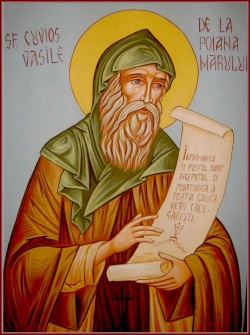
St. Basil the Elder was born in 1692, presumably in Little Russia. From his youth, driven by divine desire, he withdrew to deserted places to commune with ascetics. Around 1713, together with other monks, he founded the Dologuțu Skete in the forest on the border of Wallachia and Moldavia, where he led for 20 years. Not finding peace, he built a skete in Poiana Mărului, or Merlopolyan.
In 1733, with the support of Prince Constantin Mavrocordat, he built a wooden church and cells, continuing to guide the spiritual life of the Dologuțu Skete. St. Basil achieved the status of a stavropegial monastery for the skete, which allowed him to be under the direct jurisdiction of the Metropolitan of Wallachia.
Life in the Poiana Mărului skete was organized according to the Athonite rule, and the monastery was renowned as the second Holy Mountain. Elder Basil visited Mount Athos many times and tonsured St. Paisius into the small schema, advising him to prefer communal life for the attainment of humility and repentance.
The monks of the skete engaged in translating the works of the holy fathers, such as St. Isaac the Syrian and John Climacus. St. Basil wrote prefaces to their writings, explaining the importance of inner prayer and spiritual vigilance. He emphasized that prayer should be sincere and constant, like that of the Gospel widow.
Elder Basil became renowned throughout Romanian lands and was invited to the Church Council in 1749 in Bucharest, where his faith and spiritual teaching were recognized by the bishops as immaculate and perfect.
St. Basil reposed in peace on April 25, 1767, in Poiana Mărului, where his relics rest to this day in an unknown place.
