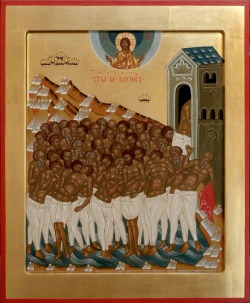
During the reign of the wicked emperor Licinius, there was a fierce persecution of Christians. In the Armenian city of Sebaste, the military commander was Agricolai, who forced Christians to offer sacrifices to idols. In Agricolai's regiment, there were forty soldiers who believed in Christ. When their faith became known, the commander summoned them and urged them to offer sacrifices to the gods, threatening them with torture if they disobeyed. The holy warriors replied that they preferred to suffer for Christ than to renounce Him.
Agricolai imprisoned them in a dungeon, where they prayed and sang psalms. In the morning, the commander called them again and tried to persuade them to offer sacrifices, but the holy warriors remained steadfast. They were subjected to various tortures, yet they did not renounce their faith. One of the soldiers, unable to endure, ran to the bathhouse but immediately fell dead.
The remaining holy warriors prayed to God, and on the third night, they were illuminated by light and heard the voice of the Lord encouraging them. The jailer, seeing the light and the miracle, also became a Christian and joined the martyrs.
The saints were forced to stand in icy water, and despite the severe frost, they suffered no harm. The wicked judges, seeing this, ordered their shins to be broken. All forty martyrs, enduring terrible torments, surrendered their souls to God, except for one, who soon also passed away.
The bodies of the saints were burned, but their bones remained incorrupt and were thrown into the river. After three days, the saints appeared to Bishop Peter and commanded him to gather their bones. The bishop, having collected the bones, placed them in a venerable place. Saint Kyrian and the other martyrs were glorified for their faith and steadfastness, leaving a memory of their feat for the edification of the faithful.
The commemoration of the holy forty martyrs is celebrated on March 9. They suffered in the year 320, when Licinius ruled the empire, but the Lord our Jesus Christ was already reigning.
