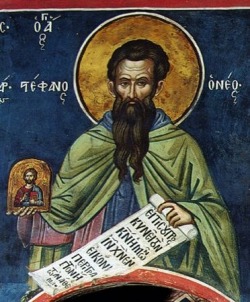
Saint Stephen the New was born in 715 in Constantinople into a pious Christian family. His parents, praying to the Lord for the birth of a son, dedicated him to God in the Vlaherna Church. At that time, Emperor Leo the Isaurian began a persecution against holy icons. His parents, having left Constantinople for Bithynia, entrusted him to the blessed John, where he spent more than 15 years learning monastic labor. After the death of his mentor, Stephen continued the ascetic struggle in his cave, and soon a monastery was formed, of which he himself became the abbot.
Emperor Constantine Copronymus, a more fierce persecutor of Orthodoxy, convened an iconoclastic council, at which icons were declared idols. Saint Stephen became known in the capital due to his righteous life and miracles. The emperor, learning of his activities, tried to win him over to his side, but unsuccessfully. The saint was slandered, accused of cohabitation with a nun, but his guilt was not proven. In the end, the saint was imprisoned, and the monastery was destroyed.
In prison, the saint remained faithful to Orthodoxy, refuting the arguments of the heretics. The emperor ordered him to be exiled to an island, where the saint continued the struggle of stylites. His fame spread throughout the empire, strengthening the faith of the people. The saint was transferred to a prison on the island of Pharos, where he spent 11 months, comforting the prisoners and offering prayers.
Upon learning of the monastery being established in the prison, the emperor sent his servants to kill the saint. However, upon seeing his holy face, they fell at his feet and asked for forgiveness. The emperor, learning the truth, accused the saint of conspiracy and sent him to execution. The saint was captured and thrown into a pit where criminals were buried. The next morning, a fiery cloud appeared over Mount Axentia, and a storm struck the capital, affecting many.
