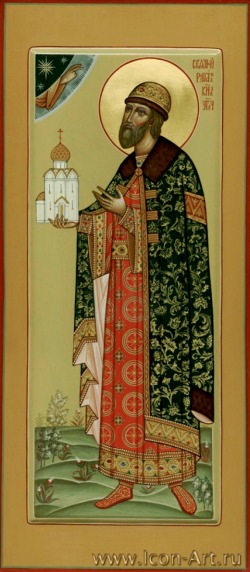
The life of the holy Prince Roman fell during the period when Rus’ was under Tatar domination. Roman’s father, Prince Vladimir of Uglich, left the city when Khan Batu conquered the Russian lands. For eight years he wandered with his family and lived in Novgorod. He later returned to Uglich and travelled to pay homage to the khan, who granted Vladimir permission to govern the lands of Uglich. After the prince’s death, his eldest son Andrei succeeded him, but he too died soon afterwards. In 1261, Roman became prince of the Uglich lands. At that time, he was twenty-six years old.
Prince Roman built many churches and cared for the poor, establishing almshouses and hospices for travellers. In 1265, he married Princess Alexandra, but they had no children. After the deaths of his wife and mother, the prince spent the remainder of his life in solitude, devoting himself to works of piety. He reposed on February 3, 1285, and his body was buried in the Cathedral of the Transfiguration.
Two hundred years later, in 1485, the incorrupt relics of the holy Prince Roman were discovered and became a source of miraculous healings. Following the events of 1605, when miracles began to occur through his relics, Patriarch Job blessed the composition of the Life and Canon of Saint Roman. In 1609, during the Lithuanian devastation, the saint’s relics were damaged, but pious devotees gathered them and placed them once again in the cathedral.
